倡
Character Story & Explanation
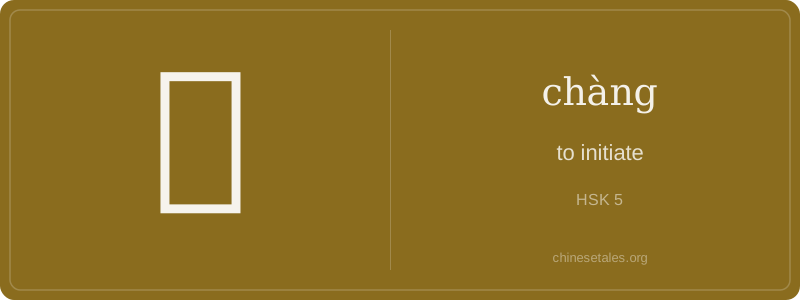
The earliest form of 倡 appears in Warring States bamboo slips as a compound: left side 亻 (person radical), right side 昌 (chāng, ‘prosperous’), which itself was originally two suns (日日) stacked — symbolizing radiant, abundant light. In bronze script, 昌 looked like two glowing discs above each other, evoking brilliance and influence. Over centuries, the right side simplified from 昌’s full double-sun form to its modern shape, while the left 亻 remained stable — creating a character literally meaning ‘a person radiating prosperity’, i.e., someone whose initiative brings collective flourishing.
This luminous origin explains why 倡 never meant ‘to whisper’ or ‘to privately suggest’. From the Book of Rites, where sages are praised for 倡德 (chàng dé, ‘championing virtue’), to Mao-era slogans like 倡勤俭 (chàng qínjiǎn, ‘champion diligence and frugality’), the character has always implied a *public, exemplary act* — not just starting something, but shining so brightly that others follow. Its visual composition — person + radiance — is a rare semantic-phonetic blend where both parts contribute meaning: 亻 signals agency, 昌 signals impact and resonance.
Think of 倡 (chàng) as the Chinese equivalent of a charismatic startup founder stepping up at a TED Talk—not just speaking, but *launching* an idea into the world with conviction and social momentum. Its core meaning isn’t mere ‘to say’ or ‘to suggest’, but to *initiate collectively*: to be the first voice that rallies others, like lighting the fuse on a shared mission. It’s inherently public, persuasive, and action-oriented—‘to advocate’ or ‘to champion’ carries its spirit better than generic ‘to initiate’.
Grammatically, 倡 is almost always transitive and appears in formal or written contexts: you 倡导 (chàngdǎo) a policy, 倡议 (chàngyì) a reform, or 倡导环保 (chàngdǎo huánbǎo) — ‘advocate environmental protection’. Crucially, it’s rarely used alone as a verb in speech; you won’t hear ‘I倡议…’ casually—you’ll say ‘我提议…’ (wǒ tǐyì, ‘I propose’) instead. Learners often overuse 倡 where 提议 or 建议 fits better; 倡 implies leadership, visibility, and societal scale—not just personal opinion.
Culturally, 倡 carries moral weight: Confucian texts praise the junzi who 倡善 (chàng shàn, ‘champions goodness’), and modern propaganda uses it deliberately—e.g., 倡导社会主义核心价值观—to signal top-down, values-driven mobilization. A subtle trap? Pronouncing it as chāng (like 昌) or confusing it with 唱 (also chàng, but ‘to sing’) — same sound, totally different intent: one moves minds, the other moves melodies.