凌
Character Story & Explanation
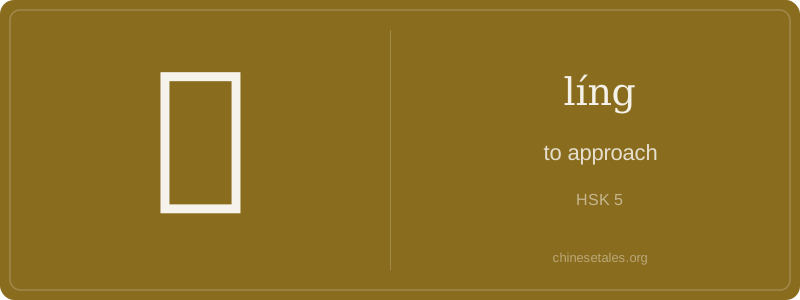
The earliest form of 凌 appears in seal script as a combination of 冫 (bīng, ‘ice’ — originally two ice crystals) on the left and 夌 (líng, a phonetic component meaning ‘to climb’ or ‘to ascend’ — itself picturing a person stepping up a slope) on the right. The 冫 radical wasn’t just decorative: ancient Chinese associated cold, sharpness, and clarity with precision and dominance — think of frost ‘rising’ over grass at dawn. Over time, the ‘climbing’ shape 夌 simplified into today’s top-heavy structure: two strokes like rising arms (), then a horizontal stroke (一), then the ‘ice’ radical (冫) anchoring the left side — 10 strokes total, mirroring the effort of ascent.
By the Han dynasty, 凌 had evolved from its concrete sense of ‘to climb over ice-covered slopes’ to a broader metaphor: ‘to rise above’, ‘to dominate’, or ‘to intrude upon’. In the Shuōwén Jiězì, it’s defined as ‘ascending beyond limits’ — capturing both physical height (凌霄, ‘reaching the clouds’) and moral transgression (凌辱, ‘to humiliate’). Its visual duality — icy stillness + upward motion — makes it uniquely suited for expressing moments where control, clarity, and elevation converge — whether in poetry, architecture (凌烟阁, ‘Pavilion of Lingering Smoke’), or describing the chilling precision of a strategist’s plan.
Imagine standing at the base of a sheer cliff at dawn — mist swirls around your feet, but above, the first light is already touching the very tip of the peak. That moment when something rises *upward* and *overcomes resistance* — not with brute force, but with quiet, unstoppable ascent — is the soul of 凌 (líng). It doesn’t mean ‘to go’ or ‘to arrive’; it means *to approach, rise over, or transcend* — often with elegance, inevitability, or even menace (think of cold creeping up your spine: 凌晨, ‘pre-dawn’ — that eerie hour when night is *overcome* by day).
Grammatically, 凌 most commonly appears in compound verbs like 凌驾 (língjià, ‘to override’), 凌晨 (língchén, ‘pre-dawn’), or as a literary verb meaning ‘to ascend over’ (e.g., 凌空, ‘soar above’). It’s rarely used alone in modern speech — you won’t say *‘I líng the mountain’*; instead, you’d say 他凌空一跃 (tā língkōng yī yuè, ‘He leapt high into the air’), where 凌 emphasizes the vertical, transcendent motion *over* space. Learners often misread it as ‘to pass’ (like 过) or ‘to arrive’ (到), but 凌 always carries tension — an upward vector, a boundary crossed, a hierarchy challenged.
Culturally, 凌 evokes classical poetry and martial arts imagery: Du Fu wrote of clouds *lingering* over peaks (凌云), and in legal contexts, 凌驾 on law implies dangerous overreach. A classic mistake? Confusing 凌 with 棱 (léng, ‘edge’) — same sound but no radical, totally different meaning. Also, don’t mix it up with 陵 (líng, ‘tomb mound’): both share the ‘hill’ phonetic, but 陵 is earthbound, while 凌 is airborne — one rests underground, the other soars above.