刺
Character Story & Explanation
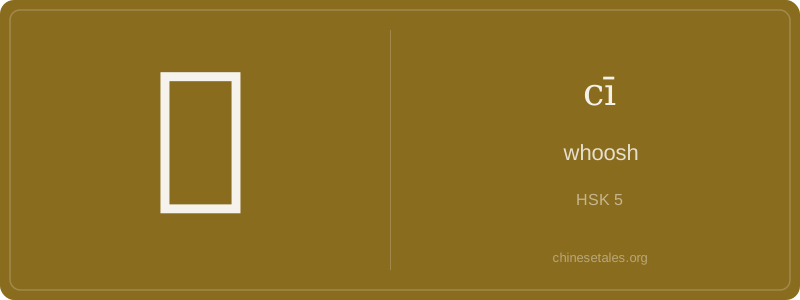
The earliest form of 刺 appears in bronze inscriptions as a compound: a hand (又 yòu) holding a sharp, pointed tool (like a stylus or awl) aimed at a target — often depicted as a standing person or a symbolic ‘heart’ shape. Over time, the hand simplified into the left-side component 朿 (cì), which itself evolved from a pictograph of thorny branches — think of sharp, upright spikes. The right side became 刂 (the ‘knife’ radical), anchoring its association with piercing action. By the seal script era, 朿 + 刂 fused into today’s clean, angular eight-stroke form: two horizontal strokes (top), then 朿’s vertical line with two diagonal ‘thorns’, capped by the knife radical’s decisive vertical stroke with a hook.
This visual logic — thorns + blade — perfectly mirrors its semantic journey. In the Shuōwén Jiězì (121 CE), 刺 was defined as ‘to pierce with a sharp object’, but by Tang dynasty poetry, writers began stretching its sound-value: Du Fu wrote of arrows 刺空 (cì kōng, ‘piercing the sky’), where the sharpness implied a sonic trail. That acoustic resonance gradually crystallized into the standalone onomatopoeia cī — not the act of stabbing, but the sound of the point breaking air. Its shape still whispers: eight strokes like eight quick stabs — sharp, singular, gone in a breath.
Let’s cut through the confusion first: 刺 (cī) isn’t about ‘stabbing’ here — that’s the far more common cì pronunciation (as in 刺激 cìjī, 'to stimulate'). When pronounced cī, it’s an onomatopoeic gem: the sharp, sudden whoosh or hiss of something thin and fast slicing air — like a needle flying, a whip cracking, or a sword drawn in one fluid motion. It’s not a verb or noun by itself; it’s a vivid sound-word you’ll hear in descriptive writing, martial arts novels, or poetic narration.
Grammatically, 刺 (cī) almost always appears reduplicated as cī cī or paired with other sound words (e.g., 刺啦 cī lā for a tearing sound), often as an adverbial phrase modifying verbs: 他刺地抽出长剑 (Tā cī de chōu chū cháng jiàn) — 'He *whooshed* the long sword out.' Notice the de: this is crucial! Learners often omit it and say *cī chōu*, but that’s ungrammatical — it must be 刺地 (cī de) to function adverbially, just like 快快地 (kuài kuài de).
Culturally, this usage thrives in wuxia and historical drama — it’s the sound of precision, speed, and quiet intensity. Western learners sometimes overuse it like English ‘whoosh!’, but in Chinese, it’s restrained and context-sensitive: never used for car engines or wind gusts (that’s 呼呼 hū hū or 咻咻 xiū xiū). And beware — mispronouncing it as cì here changes everything: 刺地 sounds like ‘stabbingly’, which is nonsensical and will make native speakers blink.