勤
Character Story & Explanation
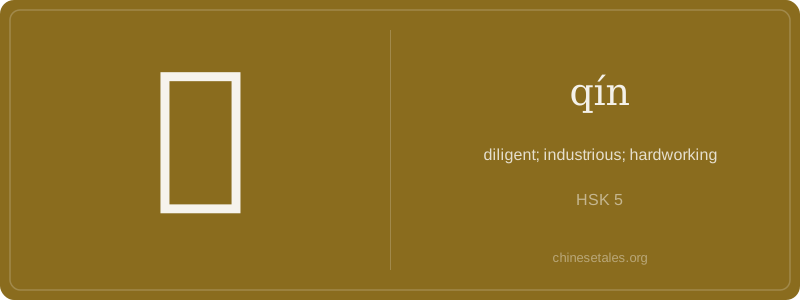
The earliest form of 勤 appears in bronze inscriptions around 1000 BCE: a combination of two elements — 芩 (a variant of 金, jīn, meaning ‘metal’ or ‘bronze’, later simplified to 堇) on top, and 力 (lì, ‘strength’, ‘effort’) below. The upper part wasn’t pictorial but phonetic — it signaled pronunciation (qín sounded close to jīn/qín in Old Chinese), while the lower 力 gave semantic weight: ‘force applied consistently’. Over centuries, 芩 evolved into 堇 (a phonetic component meaning ‘mud’ or ‘clay’, used here purely for sound), and the whole character stabilized into today’s 13-stroke form — still unmistakably anchored by the strong, downward stroke of 力.
This visual duality — sound above, strength below — perfectly mirrors its philosophical role in classical texts. In the *Analects*, Confucius praises ‘敏于事而慎于言,就有道而正焉,可谓好学也已’ — and ‘好学’ (hàoxué, ‘eager to learn’) presupposes 勤. By the Tang dynasty, 勤 was central to civil service ideals: ‘勤能补拙’ (qín néng bǔ zhuō — ‘diligence compensates for dullness’) became a proverb so ubiquitous it’s carved on scholar’s desks. Its power lies in this fusion: not raw talent, but the unwavering application of will — literally, ‘sound-backed strength’ made visible in ink.
At its heart, 勤 (qín) isn’t just 'hardworking' — it’s the quiet, sustained *push* behind mastery: the student reviewing flashcards at midnight, the chef re-kneading dough for the third time, the engineer double-checking calculations. Unlike 努力 (nǔlì), which emphasizes effort *toward a goal*, 勤 carries the nuance of *regularity, consistency, and conscientious repetition*. It’s the character you’d use to praise someone’s daily discipline, not just their one-time grit.
Grammatically, 勤 is almost always an adjective — but crucially, it rarely stands alone. You’ll nearly always see it in compounds (like 勤奋 or 勤劳) or modified by degree adverbs like 非常, 十分, or 一向. Saying *‘他很勤’* sounds incomplete and unnatural to native ears; instead, it’s *‘他非常勤奋’* or *‘她一向勤快’*. It can also appear as a verb meaning ‘to attend to diligently’ (e.g., 勤政 — ‘diligently govern’), but that usage is formal and mostly confined to political or classical contexts.
Culturally, 勤 is deeply entwined with Confucian values — especially the idea that moral cultivation and skill come not from genius, but from persistent, humble practice. Learners often mistakenly use 勤 where 勉强 (miǎnqiǎng, ‘reluctantly’) or 紧 (jǐn, ‘tight/urgent’) belong — but the real trap is overusing it bare. Native speakers instinctively pair it: 勤 + virtue (劳/奋/快/政). Also, note the tone — qín (second tone) is easily mispronounced as qǐn (third tone, ‘to sleep’) — a hilarious slip that turns ‘diligent’ into ‘sleepy’!