古
Character Story & Explanation
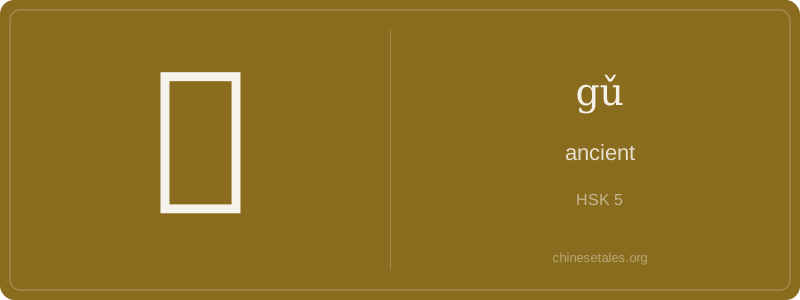
The earliest form of 古, found on Shang dynasty oracle bones (c. 1200 BCE), looks startlingly modern: a simple, upright 'mouth' (口) stacked directly above a horizontal line (一). That top element wasn’t abstract — it was a stylized representation of a *knot* or *knot-mark* on a tally stick, a primitive counting device used to record long durations. The mouth (口) below? Not about speaking — it signified *recording*, *naming*, or *declaring* — because in early Chinese writing, 'mouth' often stood for speech-as-act, especially official proclamation. So literally: 'the thing declared/recorded with the knot-mark' → 'that which has endured many tally cycles' → 'ancient.'
This minimalist two-component design (口 + 一) remained stable for over 3,000 years — rare for such an old character! By the Qin dynasty seal script, the top stroke had thickened slightly, and by regular script (楷书), it became the clean, balanced 古 we write today. Its meaning deepened alongside China’s historiography: Confucius famously said '述而不作,信而好古' ('I transmit but do not create; I believe in and love antiquity'), anchoring 古 as a moral anchor. Even today, when you write 古, you’re tracing the oldest surviving symbol for 'time measured, remembered, and honored.'
At its heart, 古 (gǔ) isn’t just a dusty dictionary label for 'ancient' — it’s a time capsule with attitude. It carries reverence (as in 古代 'ancient times'), authenticity (古法 'traditional method'), and even irony (古董商 may sell 'antiques,' but also knowingly fake ones!). Unlike English 'ancient,' which is mostly descriptive, 古 often implies cultural weight, unbroken lineage, or deliberate archaism — think 古诗 (classical poetry) versus modern free verse.
Grammatically, 古 functions almost exclusively as a noun modifier (adjectival), never as a standalone verb or adverb. You’ll never say *‘他很古’ (He is very ancient!) — that’s nonsensical. Instead, it clings tightly to nouns: 古城 (ancient city), 古籍 (ancient text), 古风 (ancient style). Crucially, it rarely appears in the predicate position; learners often wrongly try to use it predicatively like English adjectives — a classic HSK 5 trap. Also, note: it’s not interchangeable with 老 (lǎo, 'old') — 古树 means 'ancient tree' (centuries old, culturally significant), while 老树 just means 'old tree' (maybe 30 years).
Culturally, 古 evokes continuity — not just age, but preserved wisdom. In Confucian thought, 古圣先贤 ('ancient sages and worthies') aren’t relics; they’re living moral references. Misusing 古 can unintentionally signal pretension (e.g., calling your 10-year-old teacup 古杯 sounds absurdly inflated). And watch tone: gǔ (third tone) is distinct from gū (first tone, 'solitary') — mispronouncing it can turn 'ancient ritual' into 'lonely ritual'!