吐
Character Story & Explanation
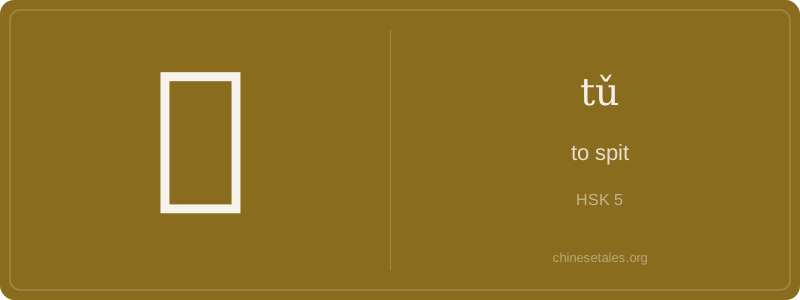
The earliest form of 吐 appears in bronze inscriptions as a combination of 口 (mouth) and 土 (earth/soil), but not as a simple compound. In oracle bone script, it was stylized as a mouth shape with a small dot or short stroke pointing outward — symbolizing something being forcefully expelled *from* the mouth. Over centuries, the ‘soil’ element (土) replaced the dot, likely because 土’s shape (a horizontal line above two short verticals) mimicked the trajectory of expelled matter, and its pronunciation *tǔ* matched the sound of expulsion — a classic case of phonetic-semantic compounding (形声字).
This visual logic stuck: the mouth radical 口 anchors the meaning in oral action, while 土 provides both sound and a sense of ‘ground-level force’ — spitting isn’t delicate; it’s earthy, direct, even slightly defiant. By the Han dynasty, 吐 already carried metaphorical extensions: Sima Qian used 吐纳 to describe breath control in Daoist cultivation, and Tang poets employed 吐锦 (‘spitting brocade’) to praise eloquent, vivid speech — as if language itself were rich fabric ejected from the throat. The character’s compactness (just six strokes) mirrors its abrupt, decisive nature.
Imagine you’re at a dim sum restaurant in Guangzhou, and your friend suddenly leans over, covers her mouth, and lets out a soft tǔ — not a full spit, but a quick, involuntary expulsion of air and saliva after biting into an overly spicy ginger dumpling. That’s 吐 (tǔ) in action: not just ‘spit’ as in gross bodily fluid, but the *intentional or reflexive outward ejection* — of saliva, blood, words, even emotions. It carries visceral physicality and psychological immediacy.
Grammatically, 吐 is almost always a verb, often followed by what’s expelled: 吐痰 (tǔ tán, to spit phlegm), 吐苦水 (tǔ kǔ shuǐ, to vent grievances — literally ‘spit bitter water’). Crucially, it rarely stands alone; you’ll almost never say ‘I 吐’ without specifying *what* — unlike English ‘I spit’. Learners sometimes wrongly use it like English ‘vomit’ (which is more precisely 呕吐 ǒu tù), but 吐 is lighter, faster, more active — think coughing up, blurting out, or belching forth.
Culturally, 吐 appears everywhere from classical poetry (Li Bai’s ‘吐纳天地’ — exhaling and inhaling heaven and earth) to modern slang like 吐槽 (tǔ cáo, to roast or mock online). A common mistake? Confusing it with the passive-sounding 吞 (tūn, to swallow) — they’re visual and semantic opposites! Also, don’t forget the alternate reading tù (as in 呕吐), which signals severe, involuntary expulsion — that extra tone shift adds urgency and gravity.