吵
Character Story & Explanation
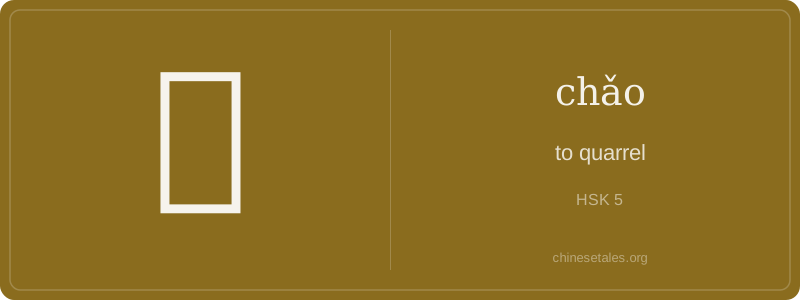
Oracle bone inscriptions show no direct precursor to 吵 — it’s a later invention, emerging in seal script around the Warring States period. Visually, it’s a brilliant fusion: left side 口 (mouth), clear and stable; right side 少 (shǎo), originally depicting a small hand or scattered grains — but repurposed here purely for sound. Over centuries, 少 simplified from a three-stroke ‘scattering’ shape into today’s clean four strokes (丶 丿 丨 丿), while 口 tightened from a full square to its modern compact box. The seven strokes feel deliberately economical — as if the scribe ran out of patience mid-argument.
The meaning crystallized early: ‘to make loud, unpleasant noise that disrupts harmony’. In the 3rd-century text Shuōwén Jiězì, it’s defined as ‘聲雜也’ (‘mixed, jumbled sounds’), emphasizing acoustic chaos over intent. By the Tang dynasty, poets used 吵 metaphorically — Li Bai wrote of wind 吵松涛 (‘quarreling with pine waves’), personifying nature’s roar. That anthropomorphism stuck: 吵 doesn’t just describe humans fighting — it evokes any clashing, grating, inescapable din where peace gets shouted down.
At its core, 吵 isn’t just ‘to quarrel’ — it’s the sound of voices colliding: sharp, overlapping, and emotionally charged. The character lives in the mouth (口 radical), but its right side 少 (shǎo, ‘few’) is a phonetic clue that also hints at *excess* — paradoxically, ‘few’ here signals *too much noise*, like shouting over one another until meaning drowns. It’s an action verb, almost always transitive or used in compound verbs (e.g., 吵架, 吵醒), and rarely stands alone in formal writing — you’ll hear it in speech far more than see it in essays.
Grammatically, 吵 often appears with aspect markers (了, 过) or as part of resultative compounds: 吵翻了 (‘quarreled so badly the situation exploded’) or 吵醒了 (‘shouted someone awake’). Learners mistakenly use it like English ‘argue’ — but 吵 implies loudness and disruption, never calm debate. You wouldn’t say 吵道理 (‘quarrel about principles’); that’s 争论. Also, 吵 is rarely used in the passive — there’s no ‘was quarreled’ construction. It’s inherently active, messy, and embodied.
Culturally, 吵 carries light stigma: it suggests loss of face, poor self-control, or social friction — think neighbors bickering over trash day, not diplomats negotiating treaties. Parents scold kids with ‘别吵!’ (‘Stop making noise!’), conflating volume with conflict. A subtle trap? Confusing 吵 with 叫 (jiào, ‘to call/shout’) — 吵 is *interactive* (at least two parties), while 叫 can be solo. And yes — even native speakers joke that 吵 is the default soundtrack of Beijing alleyways during summer afternoon naps.