呆
Character Story & Explanation
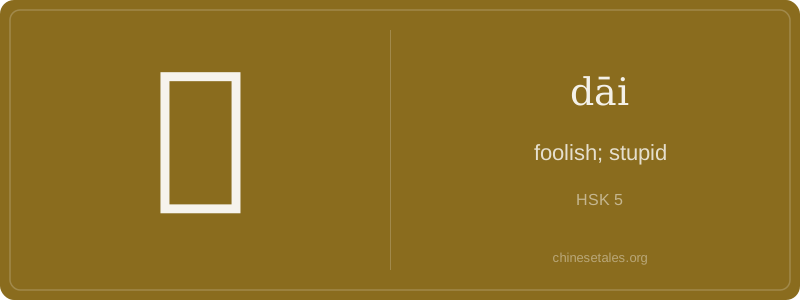
The earliest form of 呆 appears in late Warring States bamboo texts — not as a pictograph, but as a deliberate simplification of 疑 (yí, ‘to doubt’), which itself contained 口 (mouth) and 凝 (níng, ‘to congeal’). Scribes reduced the complex upper part to just ‘a square head’ (田-like shape) atop 口, evoking a face frozen mid-thought: eyes wide, mouth slack, mind momentarily unplugged. By the Han dynasty, the top stabilized into the current 木 (mù, ‘wood’) — not meaning ‘tree’, but stylized as rigid, inflexible — visually reinforcing the sense of mental rigidity. The 口 radical anchors it in speechlessness: no words come out because none are forming inside.
This visual logic shaped its meaning: from classical texts like the *Shuōwén Jiězì* (100 CE), 呆 was defined as ‘not knowing how to speak’ — a state of stunned silence, not intellectual deficiency. In Ming-Qing vernacular novels, 呆女婿 (dāi nǚxu, ‘foolish son-in-law’) wasn’t a cruel insult but a stock comic figure whose literal-mindedness exposed absurd social rules. Even today, calling someone 呆 isn’t necessarily derogatory — it’s the gentle tease you’d use for your cousin who tries to charge his iPhone with a potato.
Imagine your friend Li Wei stares blankly at a QR code for 45 seconds, blinking slowly, mouth slightly open, utterly uncomprehending — not because he’s lazy, but because his brain has genuinely short-circuited. That frozen, vacant, almost endearingly clueless expression? That’s 呆 (dāi). It’s not harsh like 笨 (bèn, ‘stupid’) or morally loaded like 愚 (yú, ‘foolish’); 呆 carries softness — it’s about *temporary mental stillness*, like a computer stuck on ‘loading’. You’d say 他呆住了 (tā dāi zhù le) — ‘He froze up’ — after hearing shocking news, not ‘He is stupid’.
Grammatically, 呆 is most alive as a verb: 呆住 (dāi zhù, ‘to freeze in place’), 呆立 (dāi lì, ‘to stand dumbfounded’), or as an adjective in fixed phrases like 呆头呆脑 (dāi tóu dāi nǎo, ‘clumsily naive’). Crucially, it’s rarely used alone as a standalone adjective (*not* ‘he is dāi’ — that sounds unnatural). Learners often overuse it like English ‘stupid’, missing its core nuance of *motionless bewilderment* — think less ‘idiot’, more ‘deer-in-headlights’.
Culturally, 呆 has surprising warmth: in internet slang, 呆萌 (dāi méng, ‘dumb-cute’) describes characters (or people!) whose blank stare somehow radiates innocence and charm — a perfect example of Chinese semantic layering. Also, watch tone: dāi (first tone) means ‘foolish’; dāi (second tone, rare) can mean ‘to stay’ (e.g., 呆在屋里), but this usage is archaic and nearly extinct in speech — stick to dāi (first tone) for HSK 5.