品
Character Story & Explanation
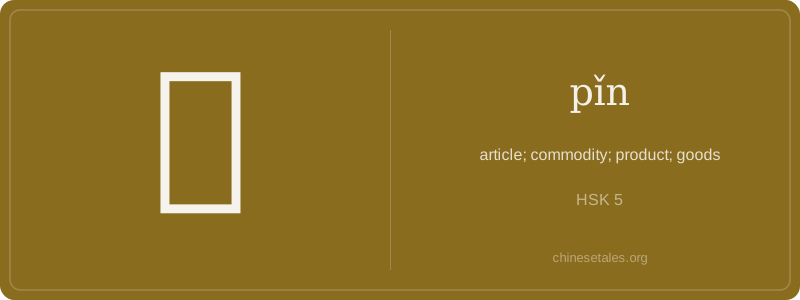
The earliest form of 品 appears in oracle bone inscriptions as three stacked 口 (mouths) — — vividly depicting repeated tasting or vocal assessment. Imagine ancient traders sampling grain, wine, and silk, then declaring verdicts aloud: one mouth for each judgment. Over centuries, the three mouths standardized into identical squares, neatly aligned vertically — the modern 品. Its nine strokes aren’t arbitrary: three mouths × three strokes each (口 = 3 strokes), totaling nine — a subtle numerical echo of completeness and tripartite evaluation.
By the Warring States period, 品 expanded beyond taste to mean 'rank' or 'class' — as in the 'Nine Ranks System' (九品中正制) used to assess officials’ moral and intellectual caliber. The Zhuangzi even uses 品 to describe 'categories of Daoist enlightenment'. That layered history — from palate to policy — explains why today’s 'product' still carries an invisible seal of judgment: every 商品 (shāngpǐn, 'commodity') arrives pre-scrutinized, as if still bearing the echo of those three ancient mouths saying, 'Yes. This qualifies.'
At its core, 品 (pǐn) is about *categorization through perception* — not just 'a thing', but a thing that’s been examined, tasted, judged, and sorted. Its radical 口 (kǒu, 'mouth') isn’t random: in ancient China, evaluating goods — especially food, wine, or tea — involved literal tasting and verbal appraisal. So 品 carries the quiet authority of connoisseurship: it’s what you *sample*, *rate*, and *classify*. That’s why it means 'product' or 'commodity' — not as inert objects, but as items assessed for quality, origin, and value.
Grammatically, 品 works flexibly: as a noun ('a high-end product'), a measure word ('three items', though rare), and in verbs like 品味 (pǐnwèi, 'to savor/appreciate'). Learners often overuse it as a generic synonym for 'thing' — but 品 never means 'stuff' or 'object' casually; it implies evaluation. You wouldn’t say 'I lost my phone 品'; you’d say 'this phone is a premium 品'. Also, note tone: pǐn (third tone) — mispronouncing it as pīn or pín changes it to unrelated words like 'pin' or 'poor'.
Culturally, 品 echoes China’s long tradition of aesthetic and moral discernment: from Confucian 'character evaluation' (品行, pǐnxíng) to modern e-commerce 'product reviews' (商品评价, shāngpǐn píngjià). A common mistake? Confusing it with 物 (wù, 'thing') — which is neutral and broad — while 品 always whispers, 'What category does this belong to? What standard does it meet?'