哎
Character Story & Explanation
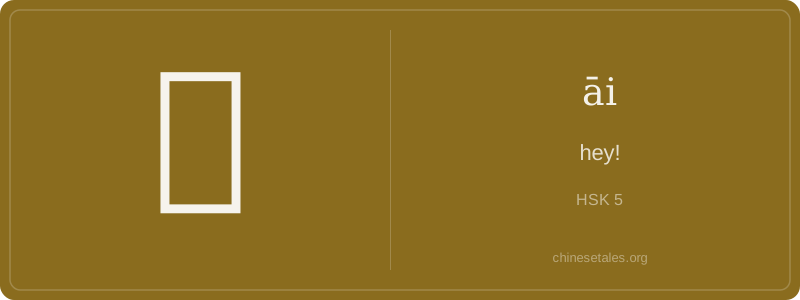
The earliest form of 哎 appears not in oracle bones, but in early clerical script (lìshū) around the Han dynasty — evolving from the phonetic-semantic compound structure we see today. Its left side 口 (kǒu, 'mouth') is unmistakable: a simple square representing the oral cavity, unchanged for millennia. The right side, 爱 (ài, 'to love'), was originally borrowed purely for its sound — but note: this isn’t the modern character for 'love' (which has 心 'heart' at the bottom); ancient 爱 lacked the heart and was written with 冖 (a covering) over 受 (shòu, 'to receive'). So early 哎 literally combined 'mouth' + 'sound of receiving' — suggesting a vocalization that draws attention *toward* something or someone.
By the Tang dynasty, 哎 solidified as a distinct interjection in vernacular poetry and storytelling texts, appearing in Dunhuang manuscripts as a marker of lively dialogue. Its visual simplicity — just eight strokes — made it perfect for rapid scribal use in performance scripts. Crucially, the 'mouth' radical anchors it firmly in the realm of speech, while the phonetic component 爱 subtly reinforces its function: not as a cry of emotion, but as an act of *relational offering* — a vocal gesture that says, 'I’m here, I’m listening, let’s connect.' This duality — phonetic borrowing fused with semantic intention — is why 哎 feels so human: it’s language performing empathy in real time.
Think of 哎 (āi) as Chinese’s verbal eyebrow-raise — a spontaneous, breathy interjection that cuts through silence like a tiny sonic flashlight. It’s not a word with dictionary definition weight; it’s pure pragmatic glue: signaling attention, expressing mild surprise, softening a request, or even gently interrupting without rudeness. Unlike English 'hey!' which can feel brash or commanding, 哎 carries an inherent warmth and social finesse — often used between friends, family, or service staff and customers to establish rapport before speaking.
Grammatically, 哎 stands alone — never modified by particles like 了 or 过, never conjugated. It’s always sentence-initial (or sometimes mid-sentence for dramatic pause), and almost always followed by a pause or a new clause. Learners mistakenly try to use it like a noun ('an哎') or attach it to verbs — but no! It’s strictly an interjection, like 'oops' or 'wow'. Also beware: tone matters intensely. āi (first tone) is friendly/neutral; ái (second tone) is more urgent or pained; ǎi (third tone) is rare and often theatrical; ài (fourth tone) sounds sarcastic or exasperated — and mispronouncing it can turn 'Hey, look!' into 'Ugh, not again!'
Culturally, 哎 is the sound of relational ease — you’ll hear it constantly in Shanghai teahouses, Beijing hutong chats, or Sichuan street food stalls. It’s so embedded in daily speech that native speakers often don’t even notice they’re using it. A common mistake? Overusing it in formal writing or exams — it belongs in spoken contexts only. And never confuse it with written exclamations like 啊 or 呀, which serve different emotional registers and grammatical roles.