唯
Character Story & Explanation
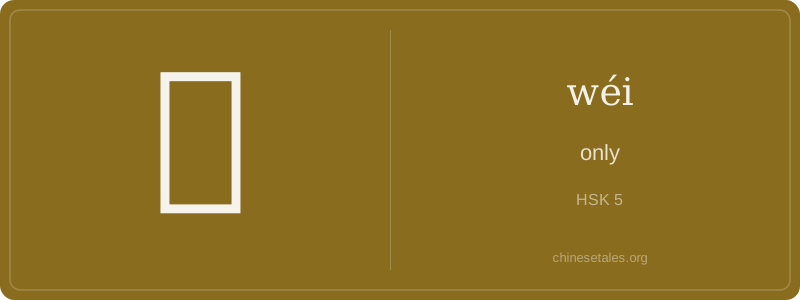
Carved over 3,000 years ago in oracle bone script, 唯 began as a pictograph combining 口 (kǒu, mouth) and 隹 (zhuī, short-tailed bird). Early forms showed a bird perched beside a mouth — not chirping, but *listening intently*. By the Zhou bronze inscriptions, the bird evolved into the right-side component 佳 (jiā), whose shape stabilized into today’s 右部: 亻+口+一+丿 — a stylized ‘person speaking with perfect clarity’. The left 口 remained central, anchoring the character in speech and intention.
This listening-bird origin explains why 唯 originally meant ‘to assent respectfully’ — as in responding ‘Yes, sir!’ with full attention. Over time, that focused, undivided assent morphed into ‘the one and only thing worthy of such attention’, giving rise to its modern sense of exclusivity. In the Book of Rites, it appears in ‘唯君子能由之’ (only the noble person can follow this path) — where ‘only’ implies moral singularity, not arithmetic limitation. Visually, those 11 strokes still echo that ancient posture: mouth open, mind narrowed to one truth.
Imagine you’re at a quiet teahouse in Suzhou, and the master pours tea into one cup — not two, not three — just that one. He says: ‘唯此一盏,心无旁骛.’ (wéi cǐ yī zhǎn, xīn wú páng wù) — ‘Only this one cup; the heart has no distractions.’ That ‘唯’ isn’t just ‘only’ — it’s emphatic, almost reverent. It singles out something with quiet authority, like a spotlight narrowing on a single blossom in a garden of a thousand.
Grammatically, 唯 is a literary adverb that usually appears at the start of a clause or sentence, often before nouns, pronouns, or verbs — never alone. You’ll see it in formal writing, essays, or classical-style speech: ‘唯有坚持才能成功’ (wéi yǒu jiānchí cáinéng chénggōng) — ‘Only persistence leads to success.’ Note: unlike 只 (zhǐ), which is neutral and colloquial, 唯 feels elevated, even solemn. Learners often mistakenly insert it mid-sentence like an English ‘only’ — but it rarely sits after the subject. Also, avoid pairing it with negation (e.g., *唯不…); use 除非 or 仅 when contrasting.
Culturally, 唯 carries echoes of Confucian precision — think of the Analects’ ‘唯上知与下愚不移’ (only the highest wisdom and lowest ignorance are unchangeable). Its tone (wéi, second tone) is calm but firm — and yes, it *can* be pronounced wěi in archaic interjections (e.g., ‘唯唯’ wěi wěi, meaning ‘yes, yes’), but for HSK 5, stick with wéi and its exclusive, singular power.