善
Character Story & Explanation
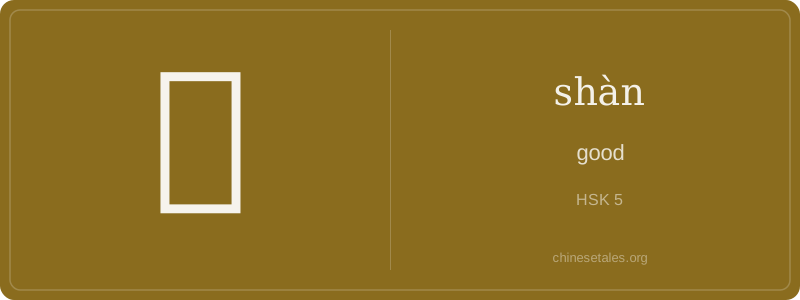
The earliest form of 善 appears on Western Zhou bronze inscriptions as a complex pictograph: at the top, a stylized sheep head (⺷, later simplified to 羊), symbolizing auspiciousness and purity in ancient ritual; below, 口 (mouth), representing proclamation or sincerity; and beneath that, two hands (廾, now hidden in the lower component) offering something precious. Over centuries, the sheep head morphed into 羊 atop 口, while the lower hands fused into the elegant, balanced 'two dots + long stroke' shape we see today—12 strokes total, each contributing to its air of graceful integrity.
This visual harmony mirrors its semantic journey: from early bronze inscriptions where 善 described ritually 'auspicious utterances', it entered the Analects (e.g., 《论语·述而》: '三人行,必有我师焉;择其善者而从之') as a marker of exemplary conduct worth emulating. The sheep wasn’t just livestock—it was a sacred animal whose wool, calm demeanor, and gentle nature embodied ideal human virtue. So 善 isn’t abstract morality: it’s goodness made visible, vocal, and offered—like a shepherd speaking truthfully over a lamb’s fleece.
At its heart, 善 isn’t just ‘good’ like a passing grade or a polite compliment—it’s *morally excellent*, the kind of goodness that radiates intention, cultivation, and harmony. Think Confucius nodding approvingly: it’s not about being harmless, but about acting with benevolent wisdom—like a doctor who heals *and* listens, or a leader who governs *and* uplifts. That warmth lives in the radical 口 (mouth), hinting at speech and expression: true 善 isn’t silent virtue—it’s spoken kindness, honest praise, or well-chosen words that mend.
Grammatically, 善 loves to wear many hats. As an adjective (shàn), it modifies nouns directly: 善意 (shàn yì, 'goodwill') or 善心 (shàn xīn, 'kind heart'). But flip it to a verb—and boom—it means 'to be good at': 他善于沟通 (Tā shàn yú gōu tōng, 'He’s skilled at communication'). Learners often stumble here, trying to say 'He is good' using 善 alone—nope! You need 善于 for skill, or 好 for simple 'good'. Also, avoid using 善 as a standalone predicate like 'He is 善'—it sounds archaic or poetic; modern Mandarin prefers 好, 优秀, or kind-hearted phrases.
Culturally, 善 carries Daoist and Buddhist weight too: in Buddhism, 善业 (shàn yè) means 'wholesome karma', while Daoist texts praise 善者不辩 ('the truly good don’t argue'). A common mistake? Over-translating English ‘good’ into 善 every time—'a good meal' is 好吃的, not *善吃的. Reserve 善 for moral, relational, or cultivated excellence—not convenience or taste!