吨
Character Story & Explanation
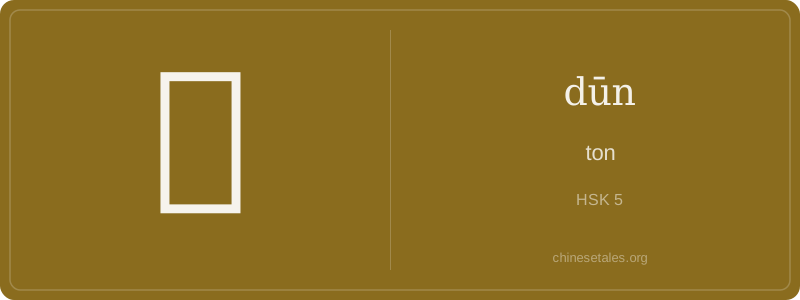
The character 吨 has no ancient oracle bone or bronze script origin — it’s a modern coinage, created around the 1900s during China’s rapid adoption of Western science and industry. Its form is deliberately constructed: the 口 (kǒu, 'mouth') radical at the top isn’t pictorial — it serves as a semantic classifier for *units of measurement*, following a pattern seen in other modern units like 千克 (qiānkè, 'kilogram') and 兆瓦 (zhàowǎ, 'megawatt'). The bottom component is 屯 (tún), which originally depicted sprouting seeds (in oracle bone script: + 一, suggesting growth anchored in earth), later evolving to mean 'to store', 'to stockpile', or 'to encamp'. Here, 屯 is used purely for its sound (tún → dūn via tone shift and dialectal influence) and its connotation of accumulation and heft.
This dual-layered design — 口 for 'unit' + 屯 for 'sound + storage/weight' — reveals how early 20th-century Chinese lexicographers solved the problem of foreign units: not by transliteration alone, but by building characters that *felt* Chinese in structure and meaning. Though absent from classical texts, 吨 appears in early Republican-era engineering manuals and railway regulations, where precise mass measurement became essential for infrastructure. Its visual simplicity (just 7 strokes) belies its conceptual sophistication: it’s a unit that doesn’t just name weight — it evokes the logistical weight of modernity itself.
At first glance, 吨 (dūn) seems like a straightforward loanword — the Chinese character for 'ton' — but it’s actually a brilliant piece of linguistic adaptation. Unlike many metric units imported in the late 19th and early 20th centuries, 吨 wasn’t borrowed phonetically from English 'ton' alone; its pronunciation dūn was deliberately chosen to echo the Mandarin word for 'to squat' or 'to settle heavily' (蹲, also dūn), subtly reinforcing the idea of massive, grounded weight. In Chinese, 吨 is never used alone — it always follows a number or measure word, like 一吨 (yī dūn) or 十万吨 (shí wàn dūn), and crucially, it’s treated as a *countable noun*, not a unit suffix like in English ('5 tons' → 五吨, not *五吨s*). This reflects how Chinese grammatically 'noun-ifies' all measurement terms.
Grammatically, 吨 behaves like any other mass noun: it pairs with classifiers only in highly technical contexts (e.g., 一‘个’吨 is *never* correct — say 一吨 instead), and it frequently appears in compound nouns like 吨位 (dūnwèi, 'tonnage') or 吨公里 (dūn gōnglǐ, 'ton-kilometer', a freight efficiency unit). Learners often mistakenly insert 的 before 吨 (e.g., *三吨的煤*) — but unless emphasizing possession or description, it’s simply 三吨煤. Also, note that 吨 refers specifically to the *metric ton* (1,000 kg), not the imperial (short/long) ton — a subtle but critical distinction in logistics and trade documents.
Culturally, 吨 signals scale, industrialization, and national capacity: headlines like ‘我国年发电量突破八万亿千瓦时,折合标准煤超三十亿吨’ (‘China’s annual electricity generation exceeds 8 trillion kWh, equivalent to over 3 billion tons of standard coal’) use 吨 to evoke macroeconomic power and environmental stakes. Interestingly, while English speakers rarely think about the ‘ton’ as culturally loaded, in Chinese, 吨 carries quiet gravity — literally and figuratively — marking thresholds where individual action gives way to systemic impact.