固
Character Story & Explanation
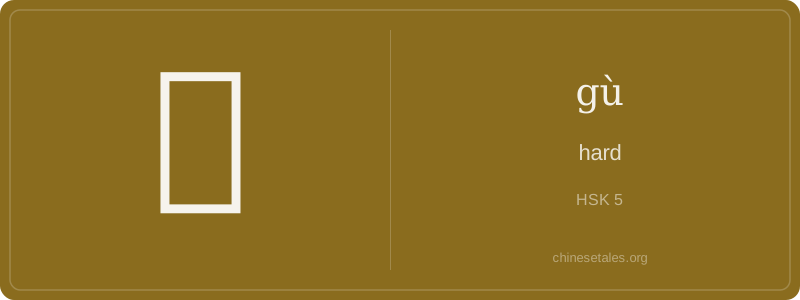
The earliest form of 固 appears in Western Zhou bronze inscriptions: a square enclosure (囗) wrapping around 古 (gǔ, ‘ancient’) — not as a phonetic component, but as a visual metaphor: an ancient, time-tested stronghold. The 囗 radical wasn’t just a ‘frame’—it was a walled city, and 古 inside signaled enduring, ancestral strength. Over centuries, the inner 古 simplified from a complex pictograph of an ancient altar and mouth to today’s clean eight-stroke form—yet the idea of ‘enclosed permanence’ never wavered.
This character’s meaning evolved precisely because of its shape: the enclosing 囗 radical suggests containment, control, and unshakeable boundaries. By the Warring States period, Mencius used 固 to describe moral resolve—‘a gentleman’s virtue is 固’—linking physical enclosure to psychological fortitude. Even today, the stroke order reinforces its essence: you draw the enclosing square first (strokes 1–3), then fill it with 古 (strokes 4–8)—as if building walls before planting roots. Its visual logic is architectural, not accidental.
Imagine a mountain fortress—walls thick, gates bolted, soldiers standing immovable. That’s the feeling of 固: not just ‘hard’ as in texture, but hard as in *unyielding*, *firmly fixed*, *resistant to change*. It’s the hardness of conviction, not concrete. In Chinese, 固 rarely describes physical rigidity alone; it’s almost always about steadfastness—of belief (固执), position (固守), or structure (巩固). You’ll hear it in formal speech and writing far more than casual chat.
Grammatically, 固 is mostly a verb prefix or adjective root—it doesn’t stand alone like ‘hard’ in English. You won’t say ‘this rock is 固’; instead, you say 固守阵地 (gù shǒu zhèn dì, ‘hold the position firmly’) or 固若金汤 (gù ruò jīn tāng, ‘as impregnable as a bronze-and-soup wall’—yes, that’s a real idiom!). Learners often mistakenly use it as a simple adjective meaning ‘hard’ or ‘tough’, but native speakers reach for 坚硬 or 坚固 instead when describing objects. 固 implies intention, effort, and resistance—not passive quality.
Culturally, 固 carries quiet weight: Confucius praised the ‘firmly grounded person’ (君子固穷), and modern Chinese media uses 固 to praise resilience—like a city ‘firmly defending’ its cultural heritage. The trap? Overusing it in spoken English-style sentences (e.g., ‘my opinion is very 固’). Native speakers would say 我的立场很坚定—not 固. Remember: 固 is the *architect* of stability—not the material itself.