夹
Character Story & Explanation
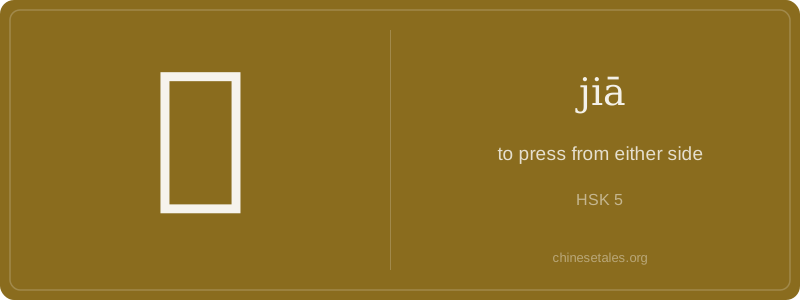
The earliest form of 夹 appears in late Shang oracle bone inscriptions as a clear pictograph: two bent arms ( + ) reaching inward toward a central figure — often a person or object — visually screaming ‘I’m squeezing you!’ Over centuries, the arms simplified into parallel horizontal strokes, the central figure became a vertical line (丨), and the base solidified into the unifying 一 radical. By the Qin small seal script, it had settled into its modern skeletal structure: three horizontals cradling a vertical, grounded by the base stroke — a perfect visual equation for bilateral force applied across a gap.
This ‘squeezing’ essence stayed remarkably consistent. In the *Zuo Zhuan*, 夹 describes troops flanking an enemy formation — literal military pressure from both sides. By the Tang dynasty, it expanded to textual usage: 夹注 (jiāzhù, ‘interlinear notes’) — commentary literally ‘inserted between’ lines of classical text. Even today, the character’s shape remains a silent instruction manual: look at those three horizontals — they’re not random; they’re your left hand, right hand, and the surface you’re pressing against. No wonder it later birthed words like 夹层 (jiācéng, ‘interlayer’) — where meaning and form fuse like two slices of bread holding truth.
At its heart, 夹 (jiā) is all about *constriction from two sides* — like your fingers pinching a piece of paper, chopsticks gripping a dumpling, or a door slowly closing on your sleeve. Visually, it’s deceptively simple: three horizontal strokes (the top, middle, and bottom ‘arms’) framing a central vertical stroke (the ‘object being squeezed’), all anchored by the radical 一 (yī, ‘one’) — which here acts less as ‘one’ and more as a stabilizing base, like the tabletop beneath your hands pressing down. This isn’t just physical pressure; it extends metaphorically to mental or situational constraint: feeling ‘sandwiched’ between deadlines, opinions, or responsibilities.
Grammatically, 夹 shines as a verb meaning ‘to clamp’, ‘to hold between’, or ‘to insert’. You’ll use it transitively: 夹菜 (jiā cài, ‘to pick up food with chopsticks’), 夹在中间 (jiā zài zhōngjiān, ‘to be stuck in the middle’). Crucially, it’s *not* used for ‘to wear’ (that’s 穿 chuān) — a common slip when learners see 夹克 (jiákè, ‘jacket’) and assume 夹 means ‘to wear’. Nope! That’s the jiá pronunciation, borrowed from English ‘jacket’ — a phonetic loan, not semantic. Also, avoid confusing it with passive constructions: 夹 doesn’t mean ‘to be夹ed’ — you need 被 or other structures for that.
Culturally, 夹 reveals how Chinese encodes action through spatial logic: no abstract ‘pressing’ — only vivid, bilateral contact. Learners often mispronounce it as jiá outside loanwords (e.g., saying *jiá* cài instead of *jiā* cài), or overgeneralize it to mean ‘to hold’ broadly (like holding a pen — use 握 wò instead). And yes — that jacket? It’s a delightful linguistic Trojan horse: written with 夹 but pronounced jiá, honoring English ‘jack-‘, reminding us that even radicals can take a vacation.