妨
Character Story & Explanation
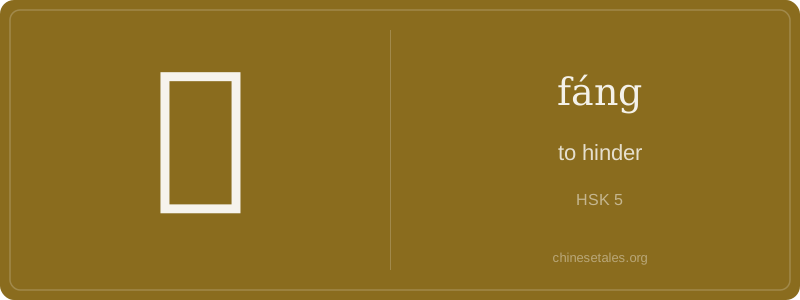
The earliest forms of 妨 appear in Warring States bamboo slips, where it was written as 妨 — identical to today’s shape. Its structure is deceptively simple: the left side is 女 (nǚ, ‘woman’), a radical that once signaled gendered roles or social expectations; the right side is 方 (fāng, ‘square’, ‘direction’, ‘method’). In oracle bone script, 方 wasn’t abstract — it depicted a ritual banner or standard held upright, symbolizing order, authority, and correct procedure. So visually, 妨 fused ‘woman’ + ‘ritual standard’ — hinting at a fundamental tension: a person (especially a woman, in early patriarchal contexts) whose presence, action, or nature disrupted established norms or orderly process.
This visual logic deepened in meaning across dynasties. In the *Book of Rites*, 妨 appears in passages cautioning against conduct that ‘hinders ritual propriety’ (妨礼). By the Tang, it shifted from moral disruption to general impediment — still carrying that quiet gravity of ‘something valuable being derailed’. The ‘woman’ radical wasn’t about misogyny per se, but reflected how early Chinese lexicography often encoded social roles into character etymology: women were seen — rightly or wrongly — as central to household harmony, and thus their actions were scrutinized for effects on stability. Even today, the radical whispers that hindrance isn’t neutral — it’s relational, contextual, and often tied to expectations of smooth functioning.
At its core, 妨 (fáng) carries the quiet tension of obstruction — not violent blocking, but subtle, almost polite interference: a delayed train, an unspoken social taboo, or well-meaning advice that accidentally derails your plan. It’s not about force; it’s about friction in the fabric of expectation. The character feels inherently relational — something *hinders* something *else*, so it almost always appears with a subject and object (e.g., 这会妨碍你的学习). You’ll rarely see it alone — it’s a verb that demands context, like a stagehand who only appears when someone else’s scene is about to go off-script.
Grammatically, 妨 is nearly always used in the pattern ‘[X] 妨碍/妨碍 [Y]’ (to hinder X), or in its common compound form 妨碍 (fáng’ài), which is slightly more formal and frequent than standalone 妨. Learners often mistakenly use 妨 as a transitive verb without the ‘碍’ partner — but modern Mandarin strongly prefers 妨碍. Also, note: it’s never used for physical barriers like walls or locked doors (that’s 挡 or 阻); instead, it targets processes, progress, health, or relationships — things that *unfold over time*. Think of it as ‘progress interference’, not ‘object blocking’.
Culturally, 妨 carries soft moral weight — in classical usage, it often appeared in warnings about behavior that might ‘hinder virtue’ or ‘hinder harmony’. Today, it surfaces in public health campaigns (‘吸烟妨碍健康’), workplace training (‘情绪妨碍判断’), and even relationship advice — always implying a gentle but consequential disruption. A classic learner trap? Confusing it with 房 (fáng, ‘room’) — same sound, totally different world: one blocks your path, the other just holds your couch.