威
Character Story & Explanation
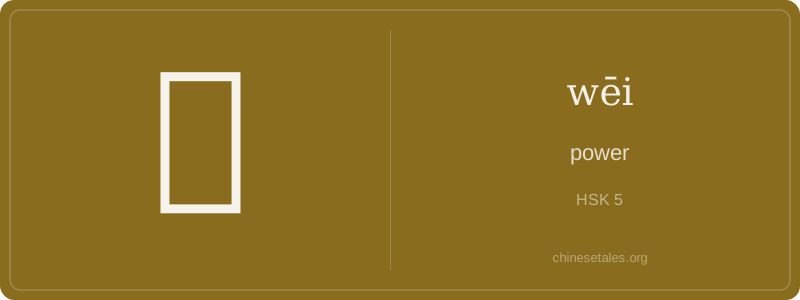
The earliest form of 威 appears in Western Zhou bronze inscriptions as a striking composite: a kneeling woman (女, nǚ) beneath a large, imposing weapon — originally depicted as a halberd (戉, yuè), later stylized into the top component we see today. That ‘halberd-over-woman’ image wasn’t literal domination — it symbolized the sovereign’s ability to enforce order, with the woman representing the governed populace or perhaps ritual submission. Over centuries, the halberd simplified into the top radical we now write as 戊 (wù), while the woman remained firmly at the bottom — a visual contract between authority and responsibility.
This imagery evolved alongside Chinese political thought. In the *Zuo Zhuan*, rulers are praised for governing with ‘威而不猛’ (wēi ér bù měng) — authoritative yet not harsh — revealing how early the concept fused power with restraint. By the Han dynasty, 威 was central to statecraft texts, distinguishing legitimate, awe-inspiring governance from mere coercion. Even today, the character’s structure whispers its origin: authority (top) rests upon human relationships (bottom — 女, historically signifying kinship and social roles), not isolation or violence.
At its core, 威 (wēi) isn’t just ‘power’ — it’s *imposing*, *authoritative* power: the kind that makes people stand a little straighter and lower their voices. Think less ‘superhero strength’ and more ‘judge’s gavel’, ‘general’s command’, or ‘teacher’s quiet glance that silences a rowdy classroom’. It carries moral weight and social gravity — power legitimized by position, virtue, or consequence.
Grammatically, 威 is almost never used alone. You’ll find it as the second character in two-syllable compounds like 威力 (wēilì, 'power/strength'), 威胁 (wēixié, 'to threaten'), or 威望 (wēiwàng, 'prestige'). It rarely functions as a verb on its own; instead, it anchors nouns and adjectives. A classic mistake? Trying to say ‘I have power’ as *wǒ yǒu wēi* — unnatural! Native speakers say *wǒ yǒu wēilì* (I have power/strength) or *wǒ hěn yǒu wēiyán* (I carry great authority). Note how 威 pairs with other characters to complete its meaning — it’s a semantic anchor, not a standalone actor.
Culturally, 威 reflects Confucian ideals: true authority isn’t brute force but earned respect — think 孔子 (Kǒngzǐ) wielding moral influence, not a tyrant’s whip. Learners often overuse it when ‘influence’ (影响 yǐngxiǎng), ‘authority’ (权威 quánwēi), or even ‘pressure’ (压力 yālì) would be more precise. Also, avoid mixing it up with 慰 (wèi, 'to comfort') — same sound family, totally opposite emotional charge!