娱
Character Story & Explanation
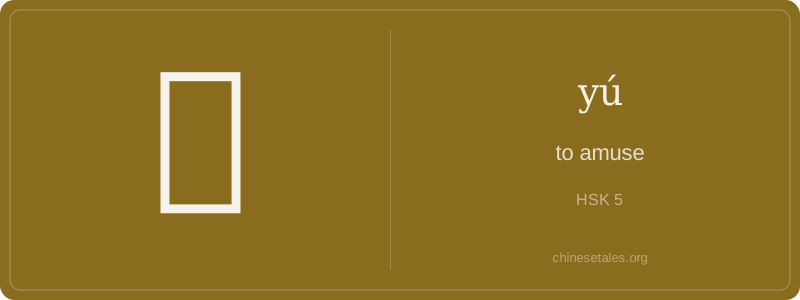
The earliest form of 娱 appears in Warring States bamboo slips as a composite: left side 女 (nǚ, ‘woman’), right side 吳 (wú, an ancient state name and phonetic component). But here’s the twist — 吳 itself evolved from an oracle bone pictograph of a *dancing shaman wearing a feathered headdress*, arms raised in ritual ecstasy. So 娱 began as ‘a woman performing sacred, joyful dance’ — not mere diversion, but spiritual uplift. Over centuries, the right side simplified from 吳 (with mouth 口 + 夊 ‘dragging feet’) to today’s 亜-like shape (actually a stylized variant of 吳), while the left 女 remained unmistakably feminine and active.
This visual origin explains everything: 娱 was never frivolous. In the *Zuo Zhuan*, ministers ‘以文娛君’ (used literary skill to delight the ruler) — a diplomatic act of soft influence. By the Tang dynasty, ‘娱宾’ (yú bīn, ‘entertain guests’) was a refined art involving poetry, music, and wine. Even today, the character’s structure whispers its history: 女 (the performer) + 吳 (the ecstatic, rhythmic energy) = deliberate, embodied joy offered to others. No wonder it resists solo usage — it’s a two-person dance encoded in ink.
At its heart, 娱 (yú) isn’t just ‘to amuse’ — it’s the gentle, intentional act of lifting someone’s spirit: sharing a joke, playing music for elders, or staging a puppet show at a village festival. The character radiates warmth and social grace, never sarcasm or mockery. It’s inherently relational — you don’t 娱 yourself in isolation; you 娱 others, or are 娱’d by them. That’s why it almost always appears in compound nouns (娱乐, 娱乐圈) or passive/agentless constructions like ‘被娱乐’ (‘being entertained’) — rarely as a bare verb in daily speech.
Grammatically, 娱 is nearly always bound: you’ll almost never say *‘wǒ yú tā’* (I entertain him). Instead, you use 娱乐 (yúlè) as a noun or verb, or pair it with verbs like 提供 (tígōng, ‘provide’) or 享受 (xiǎngshòu, ‘enjoy’). Learners often overextend it like English ‘entertain’, leading to awkward sentences — e.g., saying *‘tā yú le wǒ’* instead of the natural *‘tā ràng wǒ hěn kāixīn’* (He made me very happy). Remember: 娱 is elegant, collective, and culturally modest — not flashy or self-centered.
Culturally, 娱 carries Confucian subtlety: ancient texts like the *Book of Rites* praised ‘以乐娱亲’ (using music to delight one’s parents) as filial piety — entertainment as moral duty, not idle distraction. Modern usage still echoes that: ‘娱乐至死’ (yúlè zhì sǐ, ‘entertainment to death’) critiques society’s obsession with distraction, revealing how deeply this character is tied to ethical weight. Mistake it for casual fun at your peril — 娱 is joy with intention, care, and quiet responsibility.