孕
Character Story & Explanation
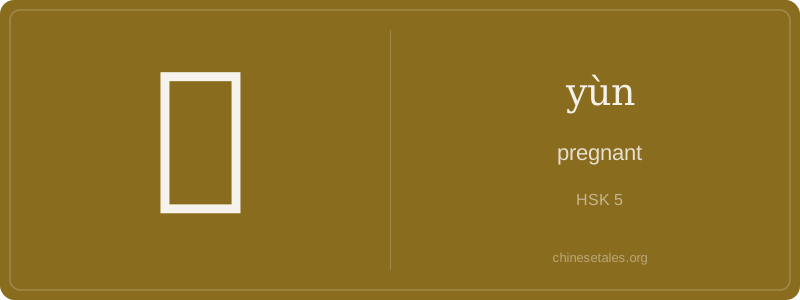
The earliest form of 孕 appears in Shang dynasty oracle bone inscriptions as a vivid pictograph: a simplified figure of a woman (represented by the radical 子, originally a baby with large head and limbs) with a rounded, enclosed shape — often drawn as a circle or oval — nestled inside her torso. That inner shape wasn’t abstract: it was a stylized embryo, sometimes even shown with tiny limbs. Over centuries, the outer ‘woman’ simplified into the modern 子 radical (3 strokes), while the inner ‘embryo’ condensed into two strokes: a horizontal line above a curved, womb-like hook — forming the complete 5-stroke character we write today.
This visual logic held firm across millennia. In the Shuōwén Jiězì (121 CE), Xu Shen defined 孕 as 'fù zhōng yǒu zǐ' — 'a child within the abdomen' — confirming its literal, physiological core. Unlike poetic euphemisms like huái yùn (literally 'holding jade', a classical metaphor for pregnancy), 孕 itself remained starkly anatomical and unembellished. Its stability is remarkable: whether in Tang dynasty medical texts or modern obstetric charts, 孕 never drifted into metaphorical abstraction — it stayed anchored to the body’s most profound biological act.
Imagine a quiet moment in a Beijing hospital waiting room: a young woman rests one hand gently on her abdomen while flipping through a prenatal guide titled Yùnqī Bǎojiàn (Prenatal Health). Her friend leans in and says, 'Nǐ yùn le ma?' — not 'Are you pregnant?' but literally 'You pregnant-le?' That tiny le signals completed change — the moment life shifted. That’s how 孕 (yùn) works: it’s not just an adjective like 'pregnant' in English; it’s a verb-root meaning 'to carry a fetus', always implying active biological process and potential transformation.
Grammatically, 孕 rarely stands alone. You’ll almost never say *'tā yùn'* as a full sentence — instead, it appears in compounds (yùnqī, yùnzhōu) or with aspect particles: yùn le (has become pregnant), zhèng zài yùn (is currently pregnant), or in formal contexts like yùn yǒu (to be pregnant with — e.g., yùn yǒu shēngmìng). Learners often overuse it like an English adjective ('she is yùn'), but native speakers prefer context-rich phrasing: 'Tā yǐjīng yùn le liǎng gè yuè' — not 'she is two months pregnant', but 'she has been pregnant for two months', emphasizing duration and change.
Culturally, 孕 carries quiet reverence — no slang, no diminutives, rarely used humorously. Unlike English’s 'expecting' or 'with child', 孕 is medically precise and socially neutral. A common mistake? Confusing it with 易 (yì, 'easy') or 均 (jūn, 'even') — visually similar at a glance, but utterly unrelated. Also, avoid using it in passive constructions like '*bèi yùn*' — that’s not Chinese. 孕 is inherently active, intimate, and untransferable: only the person carrying the pregnancy 'does' yùn.