射
Character Story & Explanation
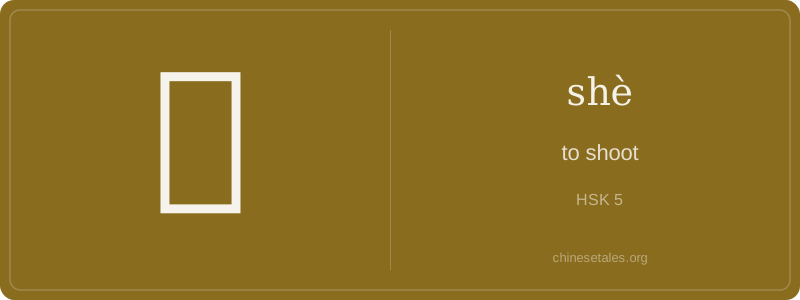
The earliest form of 射 appears on Shang dynasty oracle bones as a vivid pictograph: a drawn bow (弓) with an arrow (矢) already released, flying toward a target — sometimes even depicted with three arrowheads! By the Zhou bronze script era, the arrow simplified into a diagonal stroke, the bow became the left-side component (身 + 寸), and the right side evolved into 寸 — originally a hand measuring unit, here symbolizing the precise hand motion of releasing the string. Over centuries, the body (身) compressed into the top-left 身 component (now written as 身 without the bottom dot), and the hand-measure 寸 solidified at the bottom-right — giving us today’s 10-stroke structure: a compact, kinetic image of release anchored by deliberate control.
This duality — explosive action grounded in measured intent — defined 射’s semantic journey. In the Classic of Poetry, 射 appears in ritual odes praising archery contests that tested virtue, not just skill. Confucius himself said, 'The gentleman does not compete — except perhaps in archery' (君子无所争,必也射乎), highlighting how the act embodied harmony, humility, and self-reflection. Even as firearms replaced bows, 射 retained its conceptual weight: in modern physics, 射线 doesn’t mean 'gunshot line' — it means 'a ray projected with direction and power', carrying forward millennia of disciplined aim.
At its heart, 射 (shè) is about directed force — not just firing an arrow, but launching intention into the world. Its core feeling is precision, agency, and consequence: when you 射, something leaves your control and travels toward a target. That’s why it extends beyond archery to 'emit' (as in light or radiation), 'project' (a film), or even 'shoot' in basketball — always with purposeful trajectory. Grammatically, it’s a transitive verb that demands an object (you 射 *something*), and unlike English 'shoot', it rarely stands alone: you don’t say 'He shot!' — you say 他射中了目标 (tā shè zhòng le mù biāo, 'He hit the target'). Omitting the object or result makes it sound abrupt or poetic, not conversational.
Learners often misapply it as a general synonym for 'fire a weapon' — but 射 doesn’t cover guns automatically; for firearms, you usually need 射击 (shè jī) or specify the weapon (开枪 kāi qiāng). Also, beware false friends: 射 never means 'to photograph' (that’s 拍 pāi), nor 'to emit' in passive, abstract senses like 'the company emits carbon' (that’s 排放 pái fàng). It’s active, directional, and visual — like an arrow’s flight path.
Culturally, 射 was one of the Six Arts (六艺) of ancient Chinese gentility — alongside ritual, music, charioteering, calligraphy, and mathematics. A true scholar-warrior had to master archery not just as combat, but as moral discipline: stillness before release, alignment of body-mind-target. That ethos lingers: 射箭 (shè jiàn, 'archery') evokes tradition and self-cultivation, while 射线 (shè xiàn, 'ray') subtly carries that same sense of focused, penetrating energy — from X-rays to cosmic rays.