尾
Character Story & Explanation
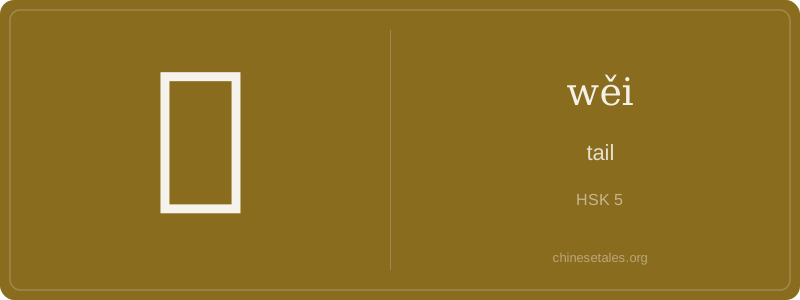
The earliest form of 尾 appears in oracle bone inscriptions as a vivid pictograph: a stylized animal body with a long, curved line extending backward — unmistakably a tail. Over time, the front part simplified into 尸 (shī), the 'corpse' radical — not because it’s morbid, but because this radical originally depicted a person *crouching* (a posture suggesting 'body' or 'form'), and became the standard component for characters related to the body’s lower or posterior parts. The right side evolved from 豕 (shǐ, 'pig') — chosen because pigs have prominent, curly tails — later simplifying to 匚 + 一 + 丨, retaining the visual rhythm of something extending behind.
By the Warring States period, 尾 was already used metaphorically: the *Zuo Zhuan* describes troops retreating ‘with tails tucked’ (尾遁 wěi dùn), evoking shame and withdrawal. In Tang poetry, ‘star tail’ (星尾 xīng wěi) referred to the fading trail of meteors — showing how early the character expanded from anatomy to cosmic imagery. Its shape remains remarkably faithful to its origin: seven strokes, each echoing that original curving extension — a rare case where the modern character still whispers its ancient picture.
At its heart, 尾 (wěi) is delightfully literal: it means 'tail' — but not just animal tails. In Chinese, it’s the go-to word for any trailing, ending, or rear part of something physical or abstract: the tail end of a line, the tail of a comet, the tail section of an airplane, even the 'tail' of a rumor spreading through a neighborhood. It carries a quiet sense of position and sequence — always *behind*, never leading.
Grammatically, 尾 often appears in compound nouns (like 尾巴 wěi·ba — the colloquial, slightly playful term for 'tail') or as a bound morpheme in technical or literary terms (e.g., 尾声 wěishēng, 'finale'). Crucially, it’s rarely used alone in speech — you’d say 狗尾巴 (gǒu wěi·ba), not just 狗尾 — which trips up learners who assume it works like English 'tail'. Also, note that while 尾 is standard written form, in everyday talk people almost always use 尾巴 (wěi·ba), adding that soft, reduplicated -ba suffix for naturalness.
Culturally, 尾 carries subtle weight: in classical texts, 'the tail' often symbolizes what’s left over, residual, or secondary — think of the idiom 首尾不顧 (shǒu wěi bù gù, 'ignoring beginning and end'), implying recklessness. A common mistake? Confusing 尾 with 尺 (chǐ, 'ruler/foot') — same radical, but different top stroke and totally unrelated meaning. And yes, it *can* be read yǐ in rare archaic contexts (e.g., in ancient rhyming poetry to fit tone patterns), but for 99.9% of modern usage, it’s firmly wěi.