幕
Character Story & Explanation
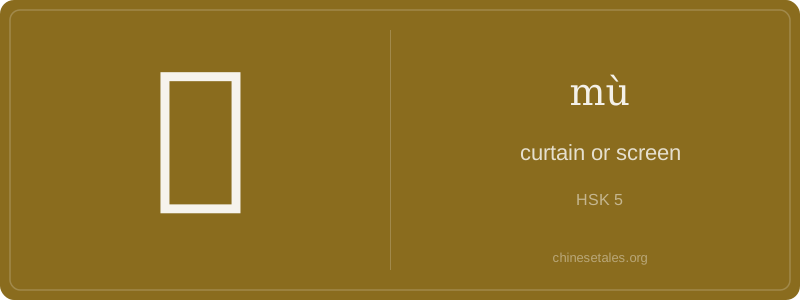
The earliest form of 幕 appears in bronze inscriptions as a pictograph combining 巾 (jīn, ‘cloth’) on the left with 莫 (mò, later simplified to 莫 → 幕) on the right — where 莫 itself was an ancient pictograph of ‘sun setting beneath grass’, implying ‘dusk’ or ‘obscuration’. Over time, the top grass (艹) and sun (日) components fused into the modern 莫, while the left-side 巾 remained clear — visually anchoring the character’s meaning in textile: cloth that obscures light, like dusk cloaking the world.
This fusion wasn’t accidental: in Zhou dynasty ritual texts, 幕 referred specifically to ceremonial canopies — temporary sacred spaces erected for sacrifices, shielding the divine from profane view. By the Han dynasty, it broadened to theatrical curtains (as in early yuefu poetry), then metaphorically to ‘stages’ of life (人生如戏,一出又一出的幕). The character’s enduring power lies in that dual origin: physical cloth + temporal boundary — making every ‘act’ in Chinese culture feel like a deliberate, framed moment.
At its heart, 幕 isn’t just ‘curtain’ — it’s a boundary that conceals *and* reveals. Think of the red velvet curtain rising in a Beijing opera house: not mere fabric, but a threshold between reality and performance, silence and spectacle. In Chinese, 幕 carries weight and drama — it implies intentionality, framing, and temporal structure (e.g., 第一幕 ‘Act One’). Unlike the neutral 帘 (lián), which is any everyday window curtain, 幕 evokes scale, ceremony, or metaphorical veiling: a ‘veil of secrecy’ (神秘的幕) or ‘the curtain of night’ (夜幕).
Grammatically, 幕 rarely stands alone; it’s almost always bound — in compounds like 落幕 (luò mù, ‘to conclude’, lit. ‘curtain falls’) or 开幕 (kāi mù, ‘to open [an event]’). Learners often mistakenly use it as a verb (‘to curtain’) — but 幕 is strictly a noun. You don’t ‘幕’ something; you ‘拉开幕’ (lā kāi mù, ‘pull open the curtain’) or ‘落下帷幕’ (luò xià wéi mù, ‘lower the curtain’). Note the fixed collocation with verbs like 拉、落、开, and the frequent pairing with 帷 (wéi) in formal contexts.
Culturally, 幕 reflects the Chinese aesthetic of controlled revelation — what’s behind the curtain matters precisely because it’s withheld. This extends to idioms like 帷幕拉开 (wéi mù lā kāi, ‘the curtain rises’), used for political shifts or life milestones. A common learner trap? Confusing 幕 with 慕 (mù, ‘to admire’) — same sound, totally different world. Pronounce it like ‘moo’ — but remember: this one hangs, doesn’t yearn.