府
Character Story & Explanation
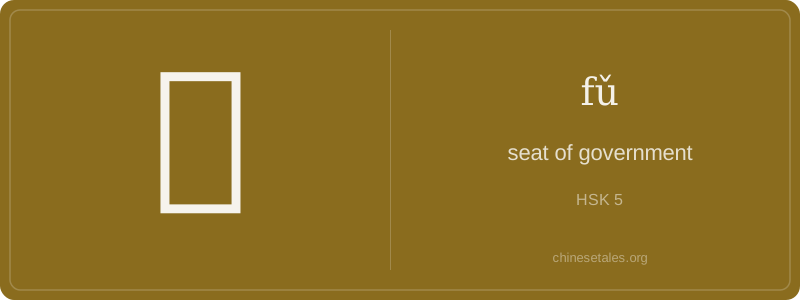
The earliest form of 府 appears in bronze inscriptions of the Western Zhou dynasty (c. 1046–771 BCE) as a compound pictograph: a roof radical (宀, later simplified to 广) sheltering a hand holding a measuring rod or tally stick (付), symbolizing official record-keeping and resource management. Over centuries, the roof evolved from 宀 to the broader, more open 广 (a ‘house-on-a-hill’ radical suggesting prominence and visibility), while 付 stabilized into its modern shape — eight strokes total, balanced and authoritative, like a gate flanked by pillars.
This visual logic shaped its meaning: a place where documents are filed, grain stored, and decrees issued — hence ‘seat of government’. In the Zuo Zhuan, states refer to their rulers’ residences as 府, emphasizing both domestic and administrative function. By the Tang dynasty, 府 denoted major regional capitals (e.g., 京兆府, Jīngzhào Fǔ), ranking just below the capital. Even today, the character’s wide, stable top stroke (the 广) visually mirrors the imposing eaves of historic yamen courtyards — a silent architectural echo of power and permanence.
At its heart, 府 (fǔ) isn’t just ‘government office’ — it’s the physical and symbolic *center of authority and order*. Think less ‘city hall’ and more ‘the quiet, imposing courtyard where decisions that shape lives are made’. It carries gravitas, tradition, and a subtle hierarchy: this is where officials reside, archives are kept, and justice is administered. Unlike generic terms like 部 (bù, ‘ministry’) or 局 (jú, ‘bureau’), 府 implies historical continuity and territorial jurisdiction — a seat with roots in imperial administration.
Grammatically, 府 almost never stands alone. It’s a bound morpheme, always paired: provincial capitals become 省府 (shěng fǔ), historical governors’ offices were 知府 (zhī fǔ), and modern administrative units retain it in names like 市府 (shì fǔ, ‘municipal government’). Learners often mistakenly use it like a free noun — saying *‘I went to the fǔ’* — but you’d say 我去了市政府 (wǒ qù le shì zhèngfǔ), not *‘我去了市府’* as a standalone phrase. It’s a suffix, not a subject.
Culturally, 府 evokes Confucian ideals of benevolent, orderly governance — the ‘courtyard’ where virtue meets power. Interestingly, it also appears in elegant, non-governmental contexts: 贵府 (guì fǔ, ‘your esteemed household’) is a highly respectful term for ‘your home’, preserving the character’s ancient association with dignified residence. A common mistake? Confusing it with 俯 (fǔ, ‘to bow’) — same sound, totally different world: one governs territory, the other bends the spine.