恢
Character Story & Explanation
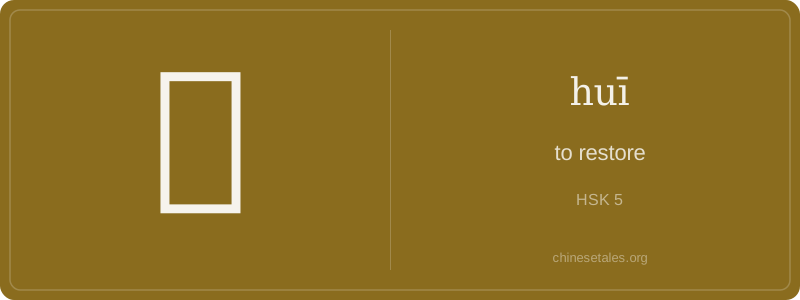
The earliest form of 恢 appears in seal script (c. 3rd century BCE), built from 忄 (the ‘heart-mind’ radical, indicating emotional or volitional involvement) and 灰 (huī, ‘ash’ — originally a pictograph of ashes scattered over a fire pit). In bronze inscriptions, 灰 depicted charred wood and fine grey residue — symbolizing something reduced to near-nothingness. Adding 忄 transformed it: not just ‘ash’, but the *intentional act of rebuilding from ash*. Over centuries, the top of 灰 simplified from 火+又 to the modern 厂+灰 structure, while 忄 retained its three-stroke heart-radical form — nine strokes total, mirroring the laborious process of restoration itself.
By the Han dynasty, 恢 shifted from literal ‘rebuilding ruins’ to abstract ‘re-establishment’: Sima Qian’s Records of the Grand Historian uses 恢 to describe Emperor Wu’s efforts to 恢先王之道 (‘restore the Way of the Former Kings’). The character’s visual duality — heart-radical + ash — became philosophical: true restoration isn’t mechanical repetition; it’s mindful resurrection born from reflection on what was lost. This nuance persists today: 恢复 always implies both loss and conscious, heart-led renewal — never mere repetition.
Think of 恢 (huī) as Chinese ‘restore’ — not like hitting Ctrl+Z on a document, but more like resurrecting a fallen dynasty or reviving a near-extinct ritual. It carries weight, intention, and often grand scale: you don’t 恢复 your coffee cup; you 恢复经济, 恢复健康, or 恢复古代礼制. Unlike English ‘restore’, which can be passive (‘the painting was restored’), 恢 is almost always transitive and active — someone *does* the restoring, and it implies deliberate, often effortful re-establishment.
Grammatically, 恢 appears almost exclusively in the compound 恢复 (huīfù), its default vehicle — like ‘re-’ + ‘cover’ in English, but far more rigid. You’ll rarely see 恢 alone in modern usage (unlike 恢復 in classical texts). Learners sometimes mistakenly use it as a standalone verb (*他恢了秩序) — a red flag. It’s also never used for emotional states (no ‘恢复心情’ — that’s 调整 or 平复); it’s for systems, conditions, functions, or institutions.
Culturally, 恢复 echoes China’s recurring historical motif of ‘returning to order after chaos’ — think of post-war reconstruction, post-pandemic recovery, or even Confucian scholars ‘restoring’ Zhou dynasty rites. A common error? Confusing it with 回 (huí, ‘to return’) — phonetically similar, but 回 is spatial or temporal movement; 恢 is ontological renewal. Also, watch tone: huī (first tone) ≠ huǐ (third tone, ‘to ruin’ — the terrifying mirror-sound!).