东
Character Story & Explanation
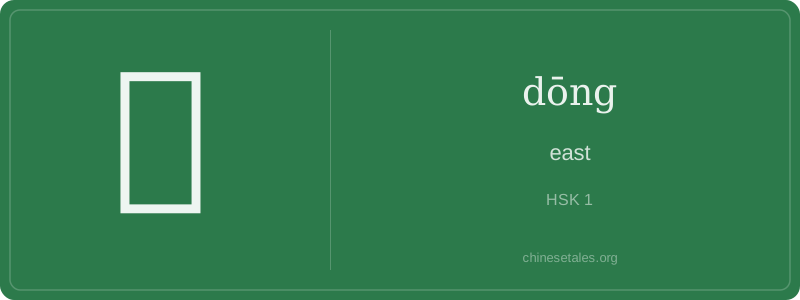
The earliest form of 东 appears in oracle bone inscriptions as a pictograph resembling a bundle tied at both ends — like a cloth sack or a wrapped package. Scholars believe it depicted a kind of ancient traveling bag used by eastern tribes or traders. Over time, in bronze script, the knots became stylized into horizontal strokes, and the central vertical stroke emerged — eventually simplifying into today’s five-stroke form: 一 (top horizontal), 丨 (central vertical), 丶 (dot top-right), 一 (middle horizontal), and 丨 (bottom vertical — though modern standard writing joins them fluidly). Visually, it looks like a simplified 'doorframe' — fitting, since doors traditionally faced east in early Chinese architecture to greet the sun.
This bundle origin explains why 东 later acquired meanings beyond direction: in classical texts like the Shuō Wén Jiě Zì (100 CE), it’s defined as ‘the direction where things begin’ — tying the physical act of packing for travel eastward with cosmic beginnings. By the Han dynasty, 东 was firmly established as the cardinal direction, associated with spring, wood, and the Azure Dragon — one of China’s Four Celestial Guardians. Its visual simplicity (just five strokes!) belies its profound role: it’s the first direction named in all four-character idioms like 东南西北 (dōng nán xī běi), and in poetry, it evokes nostalgia — think of Du Fu’s line about ‘east wind stirring old memories’. The shape may be minimal, but its resonance is immense.
Imagine standing at dawn on the Great Wall, watching the sun burst over the misty mountains — that warm, golden light flooding in from the left side of your vision? That’s 东 (dōng) in action: not just a compass point, but a visceral feeling of beginning, vitality, and orientation. In Chinese, 东 carries gentle authority — it’s the direction of sunrise, renewal, and imperial protocol (the emperor faced south, so his ‘left’ was east — the honored position for guests). It’s never abstract; it’s always grounded in real space: ‘the door faces east’, ‘my school is east of the park’.
Grammatically, 东 is almost always a noun or noun adjunct — you’ll rarely see it alone as a verb. It pairs with方位词 (directional words) like 上 (shàng, 'on/above'), 边 (biān, 'side'), or 面 (miàn, 'face/side') to form phrases like 东边 (dōng biān, 'east side') or 东面 (dōng miàn, 'eastern side'). Learners often mistakenly use 东 as an adjective ('eastern') without a classifier — but you say 东部 (dōng bù, 'eastern region'), not *东区 — unless you mean 'East District' as a proper name like 北京东区. Also: never confuse it with the homophone ‘dong’ meaning ‘cave’ (洞) — context and tone are everything!
Culturally, 东 shows up everywhere with layered warmth: your host is called 东家 (dōng jiā, 'east master') — because in traditional homes, the master sat on the east side of the main hall. And when someone says 我是东道主 (wǒ shì dōng dào zhǔ), they’re not pointing to a map — they’re proudly declaring, 'I’m the host!' (literally, 'east road master'). Yes — east = hospitality. That’s the quiet magic of 东: geography made relational, directional logic turned into social grace.