悄
Character Story & Explanation
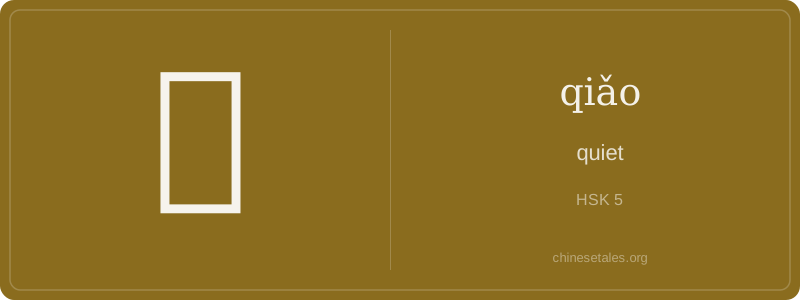
The earliest form of 悄 appears in bronze inscriptions as a combination of 心 (heart/mind, later simplified to 忄) and 肖 (xiāo), which originally depicted two interlocking bones — symbolizing likeness or resemblance. But here, 肖 wasn’t about similarity; its phonetic role was key. Over centuries, the heart radical emphasized internal state, while 肖 stabilized pronunciation. By the Han dynasty, the form crystallized into today’s 10-stroke structure: three dots (the ‘heart’ radical 忄) on the left, and 肖 — now stylized as 丷 + 月 — on the right, its strokes flowing downward like hushed footsteps.
This visual evolution mirrors its semantic journey: from early uses implying ‘quiet anxiety’ (as in《诗经》‘忧心悄悄’ — ‘my anxious heart quietly trembles’) to the Song-Yuan era, where 悄 began carrying gentle, intimate quietude — especially in love poetry and Chan Buddhist verses. Its pairing with 忄 makes it profoundly psychological: 悄 isn’t about the world being silent; it’s about the *mind choosing stillness*, or *feeling so deeply that sound falls away*. That’s why classical poets loved it — not for describing mute rooms, but for capturing the inner hush before revelation.
Imagine you’re tiptoeing past a sleeping baby — heart pounding, breath held, every muscle frozen: that’s the *feeling* 悄 captures. It’s not just ‘quiet’ as in silence; it’s quiet *with intention*, quiet *with stealth*, quiet *with emotional weight*. Think of a lover slipping away at dawn, or a spy vanishing into mist — 悄 isn’t passive absence of sound; it’s active, hushed agency. That’s why it almost never stands alone: you’ll rarely say ‘这个房间很悄’ — it’s grammatically shy, preferring compound forms like 悄悄 or adverbial phrases.
Grammatically, 悄 shines as the first character in the iconic reduplication 悄悄 (qiǎo qiǎo), meaning ‘silently’, ‘stealthily’, or even ‘secretly’. It modifies verbs directly: 悄悄离开 (qiǎo qiǎo lí kāi — ‘slip away quietly’) or 悄悄说 (qiǎo qiǎo shuō — ‘whisper’). Crucially, when used alone in literary or poetic contexts (e.g., 悄立), it carries a melancholy, introspective tone — not neutral silence, but solitude thick with unspoken feeling. Learners often mispronounce it as qiāo (like 切) — but 悄 is *always* qiǎo in this meaning (though it has a rare, archaic qiāo reading in classical texts, irrelevant for HSK).
Culturally, 悄 taps into a deep Chinese aesthetic: the power of restraint. In poetry from the Tang to Qing dynasties, 悄 appears in lines evoking quiet sorrow or quiet awe — think of a scholar gazing at moonlight on an empty courtyard, where silence isn’t empty, but full of resonance. Mistake it for mere ‘no noise’, and you miss its emotional gravity. It’s the difference between turning off a speaker and holding your breath before speaking truth.