抄
Character Story & Explanation
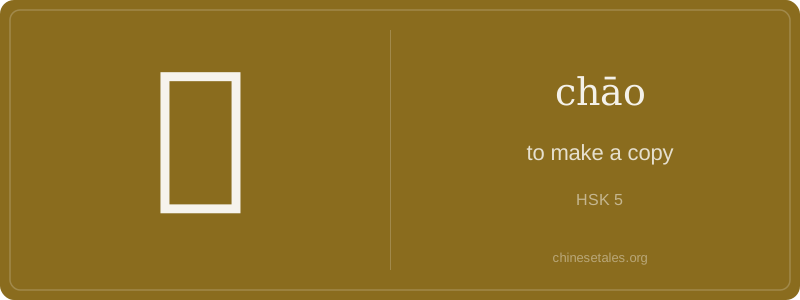
The earliest form of 抄 appears in Han dynasty clerical script, not oracle bones — it’s a relatively late semantic-phonetic compound. Its left side 扌 (hand radical) was always present, signaling physical action. The right side 少 (shǎo, 'few') wasn’t chosen for meaning but sound: in ancient Chinese, 少 had a pronunciation close to *chāo*, making it the phonetic component. Visually, the seven strokes coalesced into a compact, balanced shape: three strokes for the hand radical (a flick, a curve, a downward press), then four for 少 — dot, short slant, long slant, and final dot — evoking quick, light strokes of a brush copying text.
Originally, 抄 meant 'to lift up, to seize' (as in 抄起 — chāo qǐ, 'to snatch up'), appearing in texts like the Book of Rites to describe grasping ritual objects. By the Tang dynasty, its meaning shifted to 'to transcribe quickly by hand', reflecting the rise of civil service exam preparation — candidates frantically copying model essays and classics. The hand + 'few' structure subtly reinforces speed: writing with economy, using fewer strokes than full composition. Even today, 抄 retains traces of that urgency — it’s never slow, meticulous calligraphy; it’s efficient, functional, sometimes rushed reproduction.
At its heart, 抄 (chāo) isn’t just ‘to copy’ — it’s the quiet, sometimes uneasy, act of *reproduction with intent*. Unlike neutral terms like 复制 (fùzhì, 'to duplicate'), 抄 carries subtle weight: it implies manual effort (hence the 扌 hand radical), speed, and often a degree of informality — or even ethical ambiguity. In classroom settings, students 抄作业 (chāo zuòyè) — 'copy homework' — a phrase that instantly signals academic shortcutting, not scholarly replication. The verb is almost always transitive and requires an object: you don’t just ‘copy’; you 抄笔记 (chāo bǐjì, 'copy notes'), 抄合同 (chāo hétong, 'copy a contract').
Grammatically, it frequently appears in serial verb constructions: 他抄完就交了 (Tā chāo wán jiù jiāo le, 'He copied it and handed it in immediately'), where 完 marks completion — a hallmark of HSK 5 usage. Learners often overgeneralize it to digital contexts (e.g., saying 我抄了这个文件 for 'I copied this file'), but native speakers prefer 复制 or 拷贝 there. 抄 feels tactile, analog, human — fingers moving across paper.
Culturally, 抄 sits at a fascinating tension point: Chinese tradition deeply values textual transmission (think imperial examination rote learning), yet modern education fiercely penalizes uncited copying. This duality lives in the character itself — a hand action that can be studious diligence or academic dishonesty, depending entirely on context and intention. That moral flexibility is why teachers sigh and examiners underline it in red.