抖
Character Story & Explanation
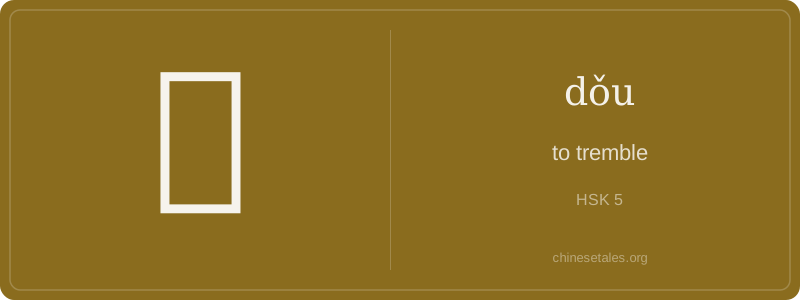
The earliest form of 抖 appears in seal script as 手 + 斗 — not the modern 斗 (dòu, ‘fight’), but an ancient variant resembling a ladle or dipper. The left side 扌 (hand radical) signals action by hand; the right was originally a pictograph of a vessel being tilted sharply to pour or scatter contents — implying abrupt, jerky motion. Over centuries, the right component simplified from a complex ladle shape into today’s 斗, retaining only its angular, unstable silhouette: two diagonal strokes crossing like trembling fingers, capped by a dot — the visual echo of a sudden jolt.
This ‘hand-tilting-vessel’ origin perfectly seeded its semantic evolution: from literal shaking-out (of grain, dust, or tea leaves) in agricultural texts like the *Qimin Yaoshu* (6th c.), to metaphorical trembling (heart抖, voice抖) in Tang poetry, and eventually to digital life — 抖音 (Dǒuyīn, ‘TikTok’) literally means ‘shaking sound’, evoking rapid, rhythmic audio bursts. The character’s seven strokes aren’t arbitrary: three for the hand radical, four for the ‘unstable vessel’ — a perfect visual mnemonic for instability in motion.
Think of 抖 (dǒu) as Chinese’s version of the ‘vibrate’ button on your phone — not just shaking, but a rapid, involuntary, often nervous or excited tremor. It’s visceral: your knees抖, your voice抖, even your courage抖 before a speech. Unlike English ‘tremble’ (which leans poetic) or ‘shake’ (which can be voluntary), 抖 almost always implies loss of control — physical, emotional, or even technological (like a shaky video).
Grammatically, it’s delightfully flexible: verb (他手抖了 — his hand trembled), reduplicated for intensity (抖抖 — give it a quick shake), or in compound verbs like 抖落 (shake off dust) and 抖擞 (to rouse oneself energetically). Watch out — you can’t say *‘抖水’ for ‘shake water’; that’s unnatural. Instead, use 抖掉 or 抖落. Also, never confuse 抖 with the noun ‘shaking’ — Chinese uses 抖动 or 颤抖 for abstract or medical contexts.
Culturally, 抖 carries subtle social weight: 抖腿 (leg-shaking) is considered rude in formal settings — a sign of impatience or disrespect — while 抖包袱 (literally ‘shake open a bundle’) is a classic comedic term for delivering a punchline. Learners often overuse 抖 where English would use ‘shake’ (e.g., shaking hands = 握手, never *抖手), or misplace tones — dǒu is third tone, so pair it with rising intonation to sound natural.