押
Character Story & Explanation
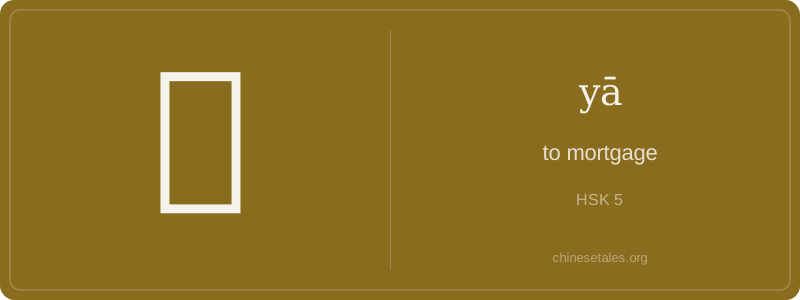
The earliest form of 押 appears in seal script (around 221 BCE), where it combined 手 (hand, later simplified to 扌) on the left with 甲 (jiǎ, ‘armor’ or ‘first of the ten heavenly stems’) on the right. But 甲 wasn’t chosen randomly: in ancient military and legal contexts, 甲 symbolized *registration*, *marking*, and *accountability*—think of soldiers inscribed on armor rosters or goods stamped with official seals. The hand + registered item visually encoded ‘placing under official record’. Over centuries, 甲 gradually stylized into the modern 友-like shape (but note: it’s not 友!), losing its armor connotation while keeping its function as a phonetic-semantic hybrid.
This evolution mirrors its semantic journey: from Warring States-era ‘sealing an agreement with a mark’ to Tang dynasty legal texts where 押 meant ‘affixing one’s signature or fingerprint to bind a contract’. By the Song dynasty, it was standard in pawn transactions—so much so that the term 押契 (yā qì, ‘mortgage deed’) appears in the famous legal compendium 《名公书判清明集》. Even today, the visual echo remains: the left hand pressing down, the right side representing something formally recorded and accountable—no wonder banks still ask for your ID and thumbprint when you 押!
At its core, 押 (yā) isn’t just about handing over collateral—it’s about *binding trust with pressure*. In Chinese commercial culture, a mortgage isn’t abstract finance; it’s a physical, solemn act: you place your asset—often property or even heirlooms—under the ‘hand’ (扌) of the lender as a guarantee. That hand-radical isn’t decorative: it signals human agency, intention, and accountability. You don’t ‘passively owe’—you actively *press* your pledge into the agreement.
Grammatically, 押 is versatile but precise: it’s a transitive verb requiring a direct object (e.g., 押房子, 押身份证), and often appears in compound verbs like 押上 (‘stake’, as in 押上全部积蓄). Learners mistakenly use it like English ‘mortgage’ as a noun (❌ 我办了押), but in Chinese, it’s almost always verbal (✅ 我把车押给了银行). It rarely stands alone—context demands clarity on *what* is pledged and *to whom*.
Culturally, 押 reflects China’s deep-rooted preference for tangible security over credit scores. During the Ming and Qing dynasties, pawnshops (当铺) used 押 daily—and the character still carries that faint scent of ink-stamped contracts and folded deeds. A common blunder? Confusing 押 with 压 (yā, ‘to press down’)—though they share pronunciation, 押 implies *legal obligation*, not physical force. Using 压 instead (e.g., 压房子) sounds like you’re literally flattening your apartment!