拍
Character Story & Explanation
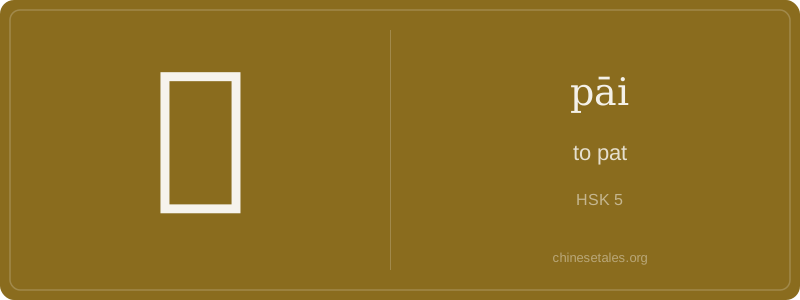
The earliest form of 拍 appears in seal script as a combination of 手 (hand, later simplified to 扌) on the left and 白 (bái, 'white') on the right — but 白 here isn’t about color. It’s a phonetic loan: ancient 白 sounded close to *pʰrak, matching the 'pāi' pronunciation. Visually, the modern character retains that elegant balance — three strokes for the hand radical (扌), five for the right side (白), totaling eight strokes — like two quick hand motions: one to raise, one to strike.
This character didn’t appear in oracle bone inscriptions, emerging later in Warring States bamboo texts, where it already meant 'to strike rhythmically.' By the Tang dynasty, poets like Bai Juyi used 拍 in phrases like 拍案而起 (pāi àn ér qǐ — 'slam the table and stand up'), capturing righteous indignation. The visual symmetry — hand + 'white' — subtly echoes purity of intent: not random hitting, but purposeful, clean impact. Even today, when you 拍, you’re not just moving your hand — you’re marking time, asserting presence, or offering reassurance — all in one precise motion.
Think of 拍 (pāi) as Chinese’s version of a percussive verb — like the crisp 'clap' of hands, the sharp 'thwack' of a tennis racket, or even the decisive 'tap' of a director’s slate. It’s not gentle stroking (that’s 摸 mō) or firm pressing (that’s 按 àn); it’s a quick, controlled, often rhythmic impact with the palm or hand — carrying energy, intention, and sometimes authority.
Grammatically, 拍 is wonderfully versatile: it can be transitive ('She拍ed his shoulder'), used in serial verb constructions ('He拍ed and laughed'), or even turned into a noun via reduplication (拍拍 pāipāi = 'a light pat'). Watch out for false friends — it doesn’t mean 'to take a photo' by itself (that’s 拍照 pāizhào, a compound), and beginners often wrongly use it where 轻轻碰 (qīngqīng pèng) — 'lightly touch' — would be more appropriate. Also, 拍 always implies contact and motion — no 'virtual pats' allowed!
Culturally, 拍 carries subtle social weight: 拍肩膀 (pāi jiānbǎng) — 'patting someone’s shoulder' — signals encouragement or camaraderie among peers, but doing it to your boss? That’s dangerously informal. And in classical poetry, 拍 often appears in musical contexts (e.g., 拍节 pāi jié — 'beat time'), linking hand motion to rhythm and harmony — a reminder that in Chinese, even gestures are tuned to cosmic order.