欢
Character Story & Explanation
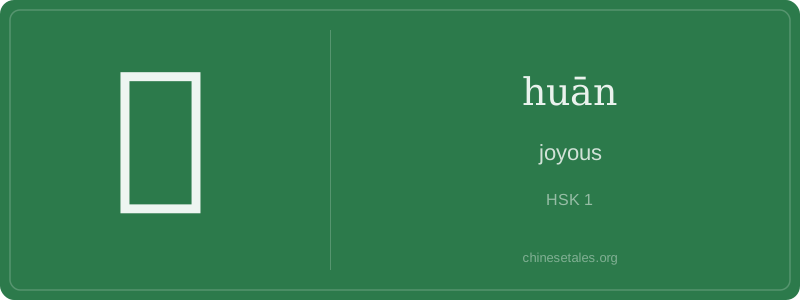
The earliest form of 欢 appears in bronze inscriptions as a combination of 又 (yòu, 'again' or 'hand') and 欠 (qiàn, 'to open mouth, yawn'). In oracle bone script, it was even more vivid: a hand gesture beside a wide-open mouth — imagine someone clapping while exclaiming with delight! Over centuries, the 又 evolved into the left-side 卉-like component (now written as 前半部 resembling 卉 but actually a stylized 又), while 欠 remained firmly rooted on the right, preserving the original ‘mouth + action’ idea. By the Han dynasty, the six-stroke modern shape stabilized — clean, balanced, and subtly dynamic, like a person leaning forward in cheerful anticipation.
This visual logic shaped its meaning: joy expressed *outwardly* — through voice, gesture, or welcome. Classical texts like the Book of Rites use 欢 to describe the harmonious delight of ritual gatherings, where music, dance, and sincere greetings created collective euphoria. Even today, 欢 rarely stands alone in classical or formal writing — it’s almost always paired (e.g., 欢欣, 欢悦), reinforcing that ancient idea: true joy is relational, vocal, and embodied. The character doesn’t depict a still smile — it captures the *moment* the smile bursts forth.
Think of 欢 (huān) as the Chinese equivalent of a spontaneous fist pump — not just 'happy,' but *joyous*, *exuberant*, and socially contagious. Unlike English 'happy' (a quiet, internal state), 欢 carries an outward, expressive energy: it’s the grin you flash when your friend walks in, the clapping at a birthday, the warmth in a host’s voice saying 'Welcome!' It’s rarely used alone as an adjective — you won’t say 'I am 欢' — but thrives in compounds (like 欢迎 or 欢乐) and as part of verbs or nouns expressing shared, active delight.
Grammatically, 欢 shines in fixed phrases and polite speech. You’ll hear it in 欢迎 (huān yíng, 'welcome'), where it’s inseparable from the verb; drop 欢 and 欢迎 collapses into just 'receive' (迎), losing all warmth. Learners often mistakenly try to use it like an English predicate adjective ('She is 欢'), but native speakers say 她很高兴 (tā hěn gāo xìng) — not *她很欢*. That’s because 欢 functions more like a root morpheme than a standalone descriptive word: it’s the joyful spark *inside* words, not the flame itself.
Culturally, 欢 is deeply tied to communal harmony — think New Year banners with 欢度春节 ('joyfully celebrate Spring Festival') or wedding couplets overflowing with 欢喜. A common error? Confusing it with 快乐 (kuài lè) — which feels lighter, more casual — or overusing it in solemn contexts (e.g., never 欢送 for 'farewell' at a funeral; that’s too upbeat!). Its power lies in its social resonance: 欢 isn’t felt alone — it’s exchanged, amplified, and ritually performed.