搞
Character Story & Explanation
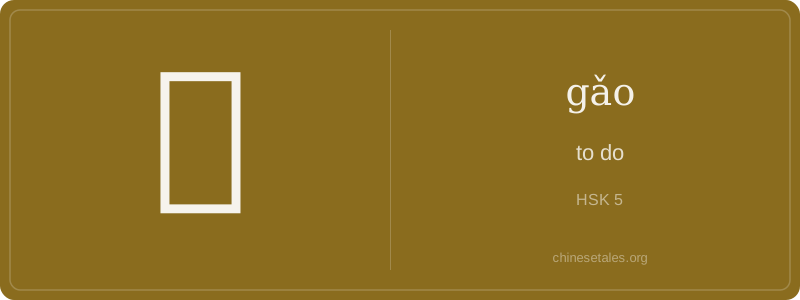
The earliest form of 搞 appears in seal script as a hand radical (扌) gripping a ‘gao’-shaped component — not a random squiggle, but a stylized depiction of a long pole with a forked tip, used in ancient times to *poke, stir, or manipulate* things deep inside vessels or hard-to-reach places. Over centuries, the pole simplified into the modern ‘Gao’ (高) component above the hand — a phonetic clue (gǎo shares sound with gāo), but also a visual echo: high effort, high engagement. The 13 strokes map perfectly to this idea — three horizontal strokes for stability, a vertical pillar, then dynamic hooks and dots representing active manipulation.
This physical origin explains why 搞 evolved beyond literal stirring. In classical texts like the *Zuo Zhuan*, variants of the character appear in contexts meaning ‘to manage, regulate, or intervene’. By the Ming dynasty, it had entered vernacular novels as a versatile verb for ‘handling affairs’, and in modern spoken Mandarin, it absorbed the energetic, hands-on spirit of everyday problem-solving. Its fusion of 扌 (hand action) and 高 (height/effort) makes it uniquely expressive: not just doing — but *doing with full bodily and mental investment*.
Imagine your friend Li Wei frantically typing at 2 a.m., muttering, 'Wǒ yào gǎo wán zhè ge bàogào!' — not ‘I will finish the report,’ but ‘I *must get this report DONE, somehow, no matter what!’ That’s 搞: the Swiss Army knife of Mandarin action verbs. It doesn’t just mean ‘to do’ — it carries urgency, improvisation, and often a dash of chaos. It’s the verb you use when the plan falls apart and you pivot on the spot: gǎo dìng (‘get it settled’), gǎo cuò (‘mess it up’), gǎo shénme? (‘What are you up to?’ — with eyebrow raised). Unlike formal verbs like ‘zuò’ or ‘bàn’, 搞 is colloquial, slightly informal, and almost always implies agency — *you* are actively manipulating, fixing, or fiddling with something.
Grammatically, 搞 is wonderfully flexible: it takes direct objects without particles (gǎo yī gè fāng'àn), forms resultative compounds (gǎo dǒng = ‘figure out’), and even becomes a noun in slang (zhè ge gǎo fa = ‘this approach’). Learners often overuse it — saying ‘gǎo cān’ instead of ‘chī fàn’ — or underuse it, missing its nuance in spoken Chinese where ‘gǎo’ replaces dozens of precise verbs for efficiency and attitude.
Culturally, 搞 is the linguistic fingerprint of pragmatic resourcefulness — think of a street vendor gǎo yī gè xiǎo tān (setting up a little stall), or engineers gǎo chū yī gè xīn fāng'àn (cooking up a new solution). But beware: in formal writing or official documents, it’s often replaced by more precise terms. And never use it with people — ‘gǎo tā’ sounds aggressive (‘mess with him’) unless context clearly signals teasing. It’s the verb that says, ‘I’m rolling up my sleeves — watch me make it happen.’