摔
Character Story & Explanation
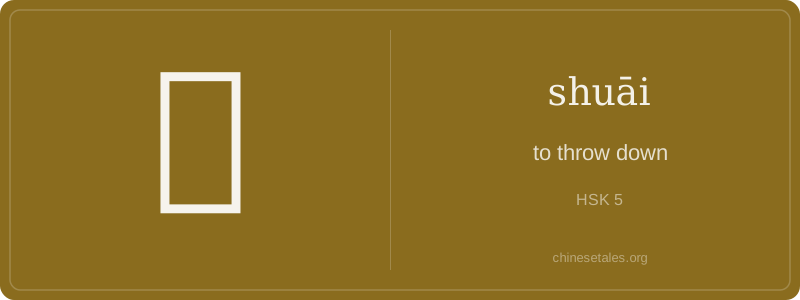
The earliest form of 摔 appears in late bronze inscriptions as a compound pictograph: left side 扌 (hand radical), right side 卒 (zú), which originally depicted a person with a cloth cap and bent knees — suggesting collapse or exhaustion. Over centuries, 卒 evolved into its modern shape, losing its cap detail but keeping the sense of sudden loss of balance. The hand radical was added to emphasize human agency: not just falling, but *being thrown down* — by oneself or another. By the Han dynasty, the character stabilized into its current 14-stroke form, with the hand action (扌) unmistakably driving the downward motion of 卒.
This visual logic anchored its meaning: classical texts like the Shuōwén Jiězì defined it as 'to cast down forcibly' (以手推卒而下). In Ming-Qing vernacular novels, 摔 appears vividly — e.g., in Journey to the West, Sun Wukong 摔妖精 (shuāi yāo jīng) — 'hurls demons to the ground' — highlighting its combative, kinetic energy. Even today, the character’s structure whispers its story: a hand (扌) actively delivering the final, decisive 'collapse' (卒) — making every use feel physically grounded and emotionally charged.
At its heart, 摔 (shuāi) isn’t just ‘to drop’ — it’s the visceral, often sudden, *intentional or forceful* act of throwing something (or someone) down with gravity, momentum, and consequence. Think: a wrestler slamming an opponent, a child hurling a toy in rage, or ice causing you to lose control and crash. It carries weight, agency, and sometimes drama — unlike neutral verbs like 掉 (diào, 'to fall accidentally') or 落 (luò, 'to descend').
Grammatically, 摔 is almost always transitive (needs an object): you 摔跤 (shuāi jiāo, 'to trip/fall' — literally 'throw down legs'), 摔杯子 (shuāi bēi zi, 'to smash a cup'), or even 摔脸 (shuāi liǎn, 'to suddenly change expression', as if 'throwing' your face). Learners often mistakenly use it intransitively ('I fell') — but that’s usually 摔倒 (shuāi dǎo) or just 倒了 (dǎo le). Also, note: it’s rarely used for gentle or passive descent — no one 摔树叶 (shuāi shù yè) for 'leaves fall'; that’s 飘 (piāo) or 落.
Culturally, 摔 carries expressive punch: 摔门 (shuāi mén, 'slam the door') implies anger; 摔话 (shuāi huà, 'toss out words') suggests abrupt dismissal. A common slip? Confusing it with 扔 (rēng, 'to throw away') — but 扔 focuses on discarding, while 摔 emphasizes downward impact and loss of control. Master 摔, and you start speaking Chinese with physicality and attitude.