撕
Character Story & Explanation
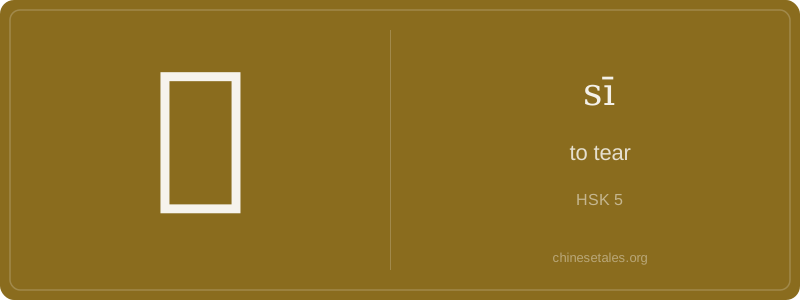
The earliest form of 撕 appears in seal script (c. 3rd century BCE), built from 扌 (hand radical) on the left and 其 (qí, originally a pictograph of a dustpan or ritual vessel) on the right. But here’s the twist: 其 was borrowed phonetically — its sound matched the spoken word for ‘tear’, while its shape evolved to suggest a pair of opposing forces pulling at something fibrous. Over time, the top of 其 simplified into two diagonal strokes resembling scissors, and the bottom became the ‘eight’-like 八 under 月 — visually echoing the jagged, frayed edge left after tearing.
This phonetic-semantic fusion solidified in the Han dynasty, when 撕 first appeared in texts like the Shuōwén Jiězì as ‘to rip with the hands’. Classical usage emphasized manual effort: ‘手撕’ (shǒu sī) appears repeatedly in Tang poetry describing torn letters or banners in battle winds. The character’s enduring power lies in how its structure mirrors its function: the left hand (扌) reaches out, while the right side (其) — now stylized into a dynamic, unbalanced shape — conveys tension, resistance, and inevitable fragmentation.
At its core, 撕 (sī) isn’t just ‘to tear’ — it’s the visceral, often irreversible act of forceful separation: ripping paper, shredding fabric, tearing emotions apart. Unlike gentle ‘cutting’ (切) or precise ‘splitting’ (劈), 撕 implies resistance, texture, and a jagged, uneven edge — think of peeling duct tape off skin or ripping open a sealed envelope with your nails. It’s tactile, urgent, and slightly messy — very much how Chinese speakers conceptualize disruption: physical, emotional, or social.
Grammatically, 撕 is transitive and almost always requires a direct object (e.g., 撕纸, not *撕). It commonly appears in resultative complements (撕破, 撕碎, 撕裂) where the suffix intensifies the degree of damage — 撕破 means 'tear open/through', 撕碎 'shred completely'. Learners often mistakenly use it for 'tear' as in crying (that’s 哭 or 流泪); 撕 never means 'to weep'. Also, avoid using it for clean cuts: you’d 切菜 (chop vegetables), never 撕菜.
Culturally, 撕 carries emotional weight — 撕心裂肺 (sī xīn liè fèi, 'tear heart, split lungs') describes agonizing grief; 撕下脸皮 (sī xià liǎn pí, 'rip off one’s face skin') idiomatically means abandoning dignity to beg. A common error? Confusing it with 斯 (sī, 'this') or 嘶 (sī, 'neigh/hiss') — homophones that share no meaning or visual logic. Remember: if there’s a hand (扌) and a sharp, scissor-like ‘其’, it’s about pulling something apart — physically or emotionally.