拦
Character Story & Explanation
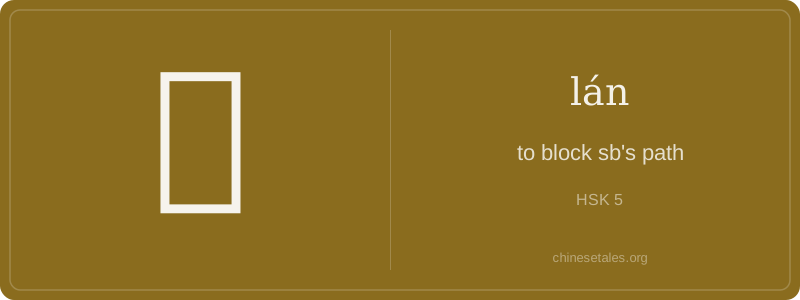
The earliest form of 拦 appears in Warring States bamboo slips — not as a pictograph, but as a phonosemantic compound already. Its left side 扌 (hand radical) signals physical action; its right side 栏 (lán, originally 'enclosure' or 'railing') provides both sound and conceptual grounding. The ancient character 栏 itself depicted wooden posts bound with rope — think of livestock pens. So 拦 emerged as 'to act with hands like a railing': to set up a human-made, temporary barrier using one’s body. Over time, the right component simplified from 栏 to 兰 (a common phonetic loan), losing its visual 'railing' detail but keeping the lán sound and the idea of containment.
This semantic link to enclosure explains why 拦 never means 'to destroy' or 'to hide' — it's always about *interruption-in-motion*. In the Classic of Poetry, we see early usage in phrases like '拦路而呼' (shouting while blocking the road), emphasizing urgency and presence. By the Tang dynasty, poets used 拦 metaphorically — Wang Wei wrote of mountains that '拦断归路' (cut off the homeward path), personifying landscape as an active agent. Even today, the hand radical reminds us: this isn’t fate or physics doing the stopping — it’s someone, right now, choosing to step forward and say: 'Not yet.'
Think of 拦 (lán) not as a passive 'barrier', but as an active, bodily intervention — someone stepping *into* your path with arms outstretched. That’s why its radical is 扌 (hand), not 门 (door) or 墙 (wall): it’s human-scale, intentional, and often urgent. In daily speech, it’s rarely about concrete walls — it’s about people stopping people: a security guard拦住你 for ID, a friend拦下你 before you walk into traffic, or even a stubborn cat that拦在门口 refusing to move. Notice the verb pattern: 拦 + object (e.g., 拦住他), and often followed by direction or purpose (拦住他问话 / 拦在路中间).
Grammatically, 拦 almost always appears in resultative or directional constructions — especially with 住 (to hold in place) or 在 (to indicate location). Learners often mistakenly use it like the English 'block' with abstract nouns ('block the plan'), but 拦 requires a *physical or agentive target*: you can 拦人 or 拦车, but not *拦计划 — instead, use 阻止 or 阻碍. Also, avoid overusing it for static obstacles: a fallen tree *blocking* the road is better expressed as 挡住 or 堵住 — 拦 implies deliberate, human-like agency.
Culturally, 拦 carries subtle social tension. In classical texts, it often appears in scenes of loyalty or duty — like a retainer 拦住逃亡的 prince — suggesting moral weight behind the gesture. Today, it’s neutral in traffic contexts, but in arguments or protests, 拦 can imply defiance: 拦警车 (blocking police cars) immediately signals civil disobedience. A common error? Confusing it with 烂 (làn, 'rotten') — same tone, similar sound, but zero relation! Just remember: hands (扌) don’t rot — they *stop*.