旦
Character Story & Explanation
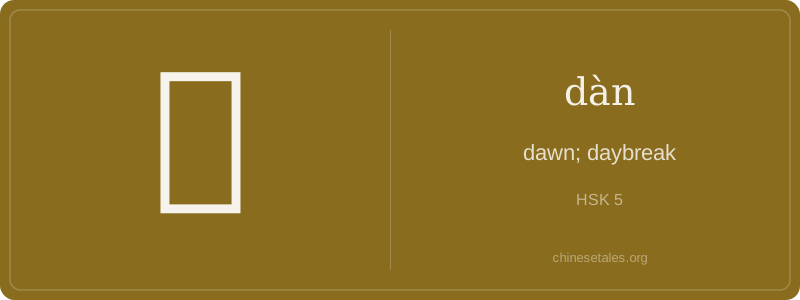
The earliest form of 旦 appears in oracle bone script as a simple pictograph: a circle (☉) representing the sun, sitting directly atop a horizontal line — the horizon. No extra strokes, no frills: just celestial body meeting earth at the precise instant light breaches the edge. Over centuries, the sun evolved into the square 日 (rì) radical, and the horizon became a clean, centered horizontal stroke — the fifth and final stroke written last. Crucially, this stroke isn’t floating above; it rests *on* the sun, like a lid lifting — a brilliant visual metaphor for light rising *from within* the darkness, not shining down from above.
This horizon-on-sun image anchored its meaning for over three millennia. In the Book of Songs, 旦 marks sacred beginnings: '雞鳴而起,日出而作' (jī míng ér qǐ, rì chū ér zuò) — 'At cockcrow they rise; at 旦, they begin work.' By the Han dynasty, 旦 had expanded to mean 'day' in formal contexts (e.g., 元旦), and by Tang poetry, it carried emotional resonance — Du Fu wrote of '孤燈寒照雨,深竹暗浮煙' (gū dēng hán zhào yǔ, shēn zhú àn fú yān), where the absence of 旦 implied lingering despair. Even today, the stroke order enacts the sunrise: you write the sun first, then — with deliberate finality — place the horizon-stroke *on top*, completing the dawn.
Think of 旦 as Chinese poetry’s version of the 'golden hour' — not just sunrise, but the hush before birdsong, the first light that turns night into promise. In English, we say 'dawn' and think of time; in Chinese, 旦 carries a quiet, almost sacred weight: it’s the liminal moment when yin surrenders to yang, when darkness isn’t banished but gently dissolved. You’ll rarely hear it alone — it’s almost always part of compounds like 元旦 (yuán dàn, 'New Year’s Day') or 一旦 (yī dàn, 'once/if'), where it adds a sense of pivotal, irreversible transition.
Grammatically, 旦 shines in classical-style constructions. In modern Mandarin, it appears most often in fixed phrases or literary register: 一旦…就… ('once… then…') is essential for HSK 5 conditionals, and 旦夕 (dàn xī) means 'morning and evening' — a poetic shorthand for 'at any moment', as in 危在旦夕 (wēi zài dàn xī, 'danger is imminent'). Learners often mistakenly use 旦 where they need 日 (rì, 'day') or 早 (zǎo, 'early'), but 旦 isn’t about clock time — it’s about symbolic threshold.
Culturally, 旦 evokes ancient ritual timing: the Duke of Zhou aligned state ceremonies with the exact moment of 旦, and in opera, 旦 roles (female characters) embody grace emerging from stillness — mirroring the character’s own visual calm. A common mistake? Writing it as 日 + 一 (correct), but misplacing the horizontal stroke *above* the sun instead of *on top* — a tiny error that breaks the whole image: no crown of light, no dawn.