个
Character Story & Explanation
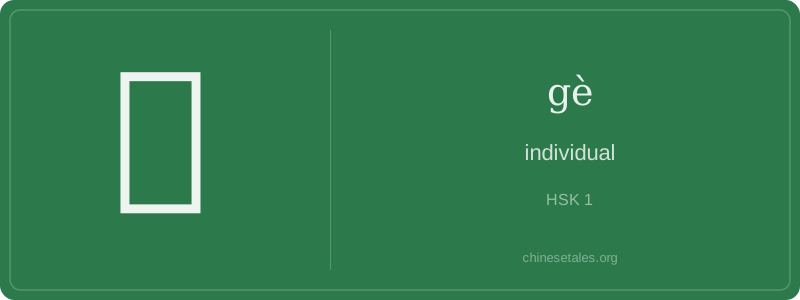
The earliest form of 个 appears in Warring States bamboo slips (475–221 BCE) as a vertical stroke 丨 with two short horizontal strokes crossing it near top and bottom — resembling a simplified ‘tree’ or ‘standing person’ with arms raised. Scholars believe it evolved from the ancient character 介 (jiè), meaning ‘between’ or ‘separate’, which itself depicted a person standing between two lines — symbolizing distinction or individuality. Over centuries, the side strokes shrank and straightened; the middle stroke shortened, and the top/bottom horizontals became the clean, angular 一 and 丿 we see today — three strokes, no curves, maximum efficiency.
This visual simplification mirrors its semantic journey: from ‘that which separates’ (as in 介) to ‘a single unit set apart from others’. By the Han dynasty, 个 was already functioning as a general classifier in texts like the *Shuōwén Jiězì*, praised for its ‘clarity in marking singularity’. Its unadorned shape — no radical suggesting wood, person, or mouth — reflects its deliberate neutrality: it doesn’t describe *what* something is, only that it exists as a discrete, countable instance — a quiet philosophical nod to the Confucian value of recognizing each person or thing in its proper place.
At first glance, 个 looks disarmingly simple — just three strokes — but it’s the Swiss Army knife of Chinese grammar: a generic measure word (classifier) used for almost anything when you don’t know the ‘correct’ one. Its core feel? Neutral, flexible, slightly informal — like the linguistic equivalent of wearing jeans to a meeting: not technically wrong, always acceptable, and somehow universally understood. Unlike English ‘a’ or ‘an’, 个 doesn’t mean ‘one’ by itself — it only gains numerical meaning when paired with a number or demonstrative: yī gè (one), zhè gè (this), nà gè (that).
Grammatically, 个 is your safety net. You’ll use it for people (yī gè rén), objects (yī gè shū), abstract ideas (yī gè wèntí), even emotions (yī gè mèng). But beware: overusing it can sound childish or lazy in formal writing — native speakers switch to precise classifiers (běn for books, zhāng for flat things, tiáo for long flexible things) when they want precision or elegance. Still, in speech? 个 reigns supreme — it’s the most frequent character in spoken Mandarin, appearing nearly twice as often as the next contender.
Culturally, 个 carries subtle weight: it implies individuation — not just ‘a thing’, but ‘a distinct, countable entity’. That’s why it’s embedded in words like gèrén (individual) and gèxìng (personality). Learners often mistakenly use it *without* a number/demonstrative (e.g., *‘Wǒ yǒu gè shū’ — missing ‘yī’), or confuse it with the verb ‘to be’ (shì). Remember: 个 never stands alone — it’s always anchored by yī, zhè, nà, or another quantifier.