沉
Character Story & Explanation
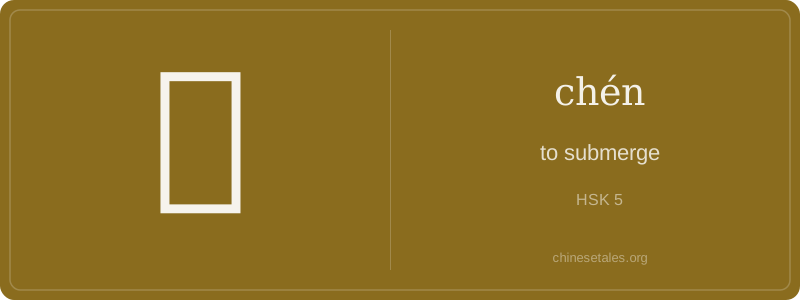
The earliest form of 沉 appears in bronze inscriptions as ⿰水冘 — a radical 氵 (water) plus 冘 (yín), a phonetic component that originally depicted a person with a dragging foot, suggesting movement downward. Over time, 冘 simplified into 今 (jīn), losing its pictographic leg but keeping the sound link (ancient pronunciation of 今 was closer to *gəm*, overlapping with 沉’s *dʒʰəm*). By the Han dynasty, the modern shape 沉 emerged: three dots of water on the left, 今 on the right — a perfect marriage of meaning (water + downward motion) and sound (今 hints at pronunciation).
This visual logic shaped its semantic evolution: from literal submersion (《诗经》: '沉璧于河', 'sank the jade tablet in the river') to psychological weight (Du Fu’s line '沉郁顿挫', describing his own poetic style’s profound, brooding intensity). The character never lost its aquatic root — even when describing silence (沉默, chénmò), it’s as if sound has *sunk below the surface*, leaving only pressure. Its stability in form across 2,500 years reflects how deeply Chinese culture associates weight, stillness, and depth with water’s quiet authority.
Think of 沉 (chén) as Chinese’s version of the 'sinking feeling' — not just physically submerging, but emotionally dragging down, mentally weighing in, or atmospherically settling in. Unlike English ‘sink’, which is mostly literal (a ship sinks), 沉 carries visceral weight: a voice can 沉 (drop in pitch), silence can 沉 (grow heavy and thick), and grief can 沉 (settle deep in the chest). It’s rarely used alone as a verb; instead, it appears in compound verbs (如 沉没, 沉思) or as an adjective (沉闷, 沉重) — much like how English uses 'heavy' metaphorically ('a heavy silence') but Chinese makes the weight *grammatically visible* through this one character.
Grammatically, 沉 is rarely the main verb in a simple SVO sentence. You won’t say *‘He chén the stone’* — instead, it’s embedded: 他把石头沉下去 (tā bǎ shí tou chén xià qù, 'He sinks the stone down') or used adjectivally: 这个问题很沉 (zhè ge wèn tí hěn chén, 'This issue feels weighty'). Learners often wrongly treat it like a transitive verb à la 'to sink', forgetting it usually needs aspectual particles (了, 下去), directionals, or compounds to function naturally.
Culturally, 沉 evokes Daoist and poetic sensibilities — stillness that contains power, like water holding depth beneath calm surface. In classical poetry, 沉 is paired with moonlight (沉月), dusk (沉暮), or sorrow (沉忧) to suggest quiet, irreversible descent. A common mistake? Confusing 沉 with 深 (shēn, 'deep') — but while 深 describes vertical measurement, 沉 conveys *process* and *affective gravity*. Also, avoid overusing it for 'sad'; 悲伤 or 难过 are more direct — 沉 implies something heavier, slower, more atmospheric.