泪
Character Story & Explanation
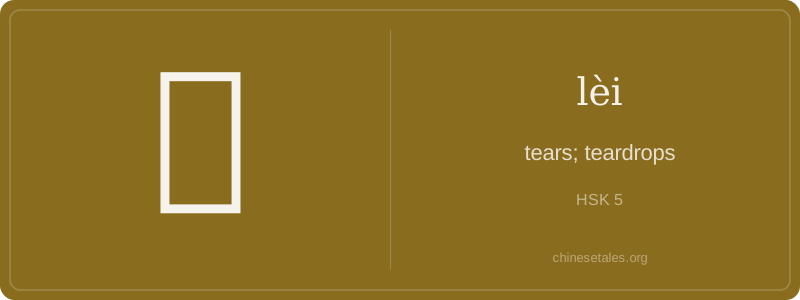
The earliest form of 泪 appears in small seal script (c. 200 BCE), evolving from a bronze inscription that combined 氵 (the ‘water’ radical, indicating fluidity and origin) with 戾 (lì, later simplified to 户+犬-like strokes), which originally meant ‘to deviate’ or ‘to bend sharply’ — visually suggesting the *path* a tear takes as it veers down the cheek. Over centuries, the right side morphed: the top became 户 (hù, ‘door’), symbolizing the eye’s ‘threshold’, while the bottom evolved into a stylized ‘dog’ (犬) shape — not literally about canines, but echoing ancient phonetic borrowing where 犬 (quǎn) sounded close to early pronunciations of ‘tear’. By the Song dynasty, the modern 8-stroke form stabilized: three dots for water, then 户 + 廾 — wait, no! Actually, it’s 氵 + 户 + 丶 — but the lower part is now understood as a simplified remnant of 戾, not ‘hand’ or ‘dog’.
In classical texts, 泪 first appears in the *Book of Songs* (Shījīng), where tears mark sincerity and moral weight: ‘涕泗滂沱’ (tì sì pāng tuó, ‘snot and tears flood’) describes grief so profound it breaks ritual composure. Later, Tang poets like Du Fu used 泪 to convey historical sorrow — ‘感时花溅泪’ (gǎn shí huā jiàn lèi, ‘moved by the times, flowers shed tears’) personifies nature weeping alongside humans. Crucially, 泪 was always *visible*, *measured*, and *meaning-laden*: unlike English ‘tear’, it resists abstraction — you don’t ‘have a tear’ casually; you *shed*, *hold back*, or *wipe away* 泪 — making its visual flow inseparable from its emotional grammar.
Imagine a quiet moment in a Beijing teahouse: an elderly man reads a letter from his long-lost brother, and a single tear slips down his cheek — not sobbing, not wailing, just that silent, glistening 泪 (lèi) tracing a slow path. That’s the heart of this character: it’s not just ‘tears’ as a biological fact, but tears as emotional evidence — dignified, intimate, often unspoken. In Chinese, 泪 almost never stands alone; it appears in compounds like 眼泪 (yǎn lèi, ‘eye-tear’) or 泪水 (lèi shuǐ, ‘tear-water’), and even in poetic or literary contexts, it carries gravity — you’d say 她流下了眼泪 (tā liú xià le yǎn lèi) ‘she shed tears’, not *她泪了. Learners often overuse it like English ‘tear’ — but 泪 is rarely pluralized, never used verbally without support, and almost never appears bare in speech.
Culturally, 泪 isn’t just sadness: it can signal gratitude (感动的泪, gǎndòng de lèi), relief (如释重负的泪), or even joy (喜极而泣, xǐ jí ér qì — ‘cry from overwhelming joy’). A common mistake? Writing 涙 (a Japanese variant) or confusing it with 洒 (sǎ, ‘to sprinkle’) — both visually similar but semantically worlds apart. Also, note that 泪 is strictly for *human* tears; animal ‘tears’ use different phrasing (e.g., 狗的眼睛湿了, ‘the dog’s eyes got wet’).
This character also anchors many idioms and metaphors: 泪如雨下 (lèi rú yǔ xià, ‘tears fall like rain’) evokes helplessness; 肝肠寸断的泪 (gān cháng cùn duàn de lèi, ‘tears from a liver-and-intestines-cut-in-pieces heart’) shows deep sorrow. It’s never trivial — even in modern slang, 泪目 (lèi mù, ‘tear-eyed’) signals visceral emotional resonance online, like seeing a reunion video. So when you see 泪, think less ‘water from eyes’ and more ‘heart leaking light’.