浓
Character Story & Explanation
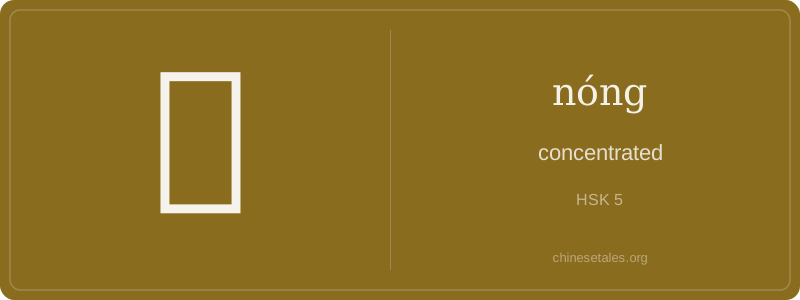
The earliest form of 浓 appears in seal script (c. 3rd century BCE), where it combined 氵 (water radical, indicating liquid-related meaning) with 农 (nóng, ‘to farm’—but originally picturing a hand holding a farming tool above soil). Over centuries, the ‘soil’ and ‘tool’ simplified into the modern 农 component—its strokes condensed from 12 to 6, while the water radical stabilized as three dots. Visually, the nine strokes now balance left (氵: three quick flicks) and right (农: six deliberate, grounded strokes)—a perfect visual metaphor: liquid + cultivation = something deliberately intensified, like stewed broth or ink ground thick on an inkstone.
This fusion wasn’t arbitrary: ancient Chinese linked agriculture with concentration—irrigating fields meant channeling water densely; grinding ink required pressing soot firmly into paste. By the Tang dynasty, 浓 was already describing ‘rich color’ (e.g., Du Fu’s ‘山色浓如染’—mountain hues as if deeply dyed) and ‘deep feeling’ (Bai Juyi’s ‘情浓不自禁’—affection so intense it couldn’t be restrained). Its core idea has never wavered: *intentional density*, born from human labor meeting elemental substance.
At its heart, 浓 isn’t just about ‘concentration’ in a lab sense—it’s about *intensity of presence*: thick fog clinging to hills, rich broth steaming with umami, or deep, unspoken emotion hanging in the air. The character pulses with sensory weight—think of the way ‘浓’ makes your mouth water (for flavor) or your breath catch (for feeling). It describes density that you can almost touch: 浓雾 (nóng wù, thick fog), 浓情 (nóng qíng, deep affection), even 浓妆 (nóng zhuāng, heavy makeup)—where ‘heaviness’ implies deliberate, vivid impact.
Grammatically, 浓 is an adjective that usually appears before nouns (浓茶, 浓厚的兴趣) or after verbs like 是, 显得, or 感觉 (这汤很浓 / 这气氛显得很浓). Crucially, it rarely stands alone as a predicate without a degree adverb like 很 or 特别—saying *‘这茶浓’* sounds incomplete to native ears; it needs *‘这茶很浓’* or *‘这茶太浓了’*. Learners often overgeneralize it to mean ‘strong’ across all contexts, but 浓 never means ‘physically powerful’ (that’s 强) or ‘intense in effort’ (that’s 猛 or 用力)—it’s always about *density, saturation, or richness of quality*.
Culturally, 浓 carries poetic gravity: classical poets used it for autumn hues (浓秋), lingering incense (浓香), and emotional thickness (情意正浓). A common slip? Using 浓 for ‘strong coffee’—while understandable, natives prefer 苦 (bitter) or 醇 (rich, mellow) for taste nuance; 浓 here risks sounding like ‘over-extracted, harsh.’ Also, watch tone: nóng is fourth tone—confusing it with nòng (fourth tone, ‘to mess with’) is rare, but mixing up the radical (氵 vs. 扌) visually trips up beginners.