炸
Character Story & Explanation
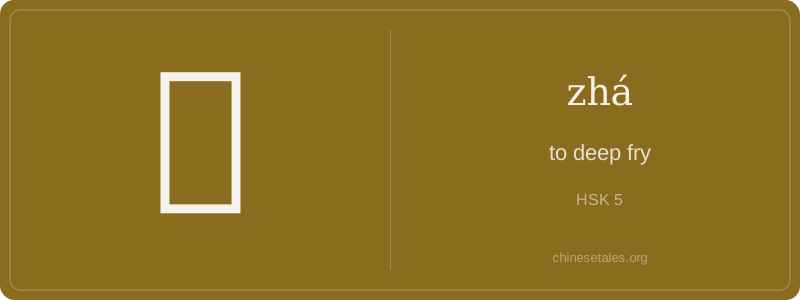
The earliest form of 炸 appears in Han dynasty clerical script, evolving from the radical 火 (fire) on the left — unmistakable with its four-dot base representing flames — and 又 (yòu) on the right, originally a pictograph of a right hand. Over centuries, 又 simplified and rotated, becoming the modern ‘right-hand’ component that now looks like a bent arm holding something — fittingly, the hand that dips food into hot oil. The nine strokes weren’t arbitrary: the fire radical demands attention (four dots + vertical stroke), while the right side’s three strokes echo the quick, decisive motion of plunging and retrieving.
Originally, 炸 didn’t mean ‘fry’ at all — in early texts like the *Shuōwén Jiězì* (121 CE), it described sudden, violent dispersal (like sparks flying), later extending to explosions (zhà). Only by the Song dynasty did culinary usage emerge, likely because deep-frying produced the same sensory shock: intense heat, rapid expansion, audible bursts. By Ming-Qing times, it was standard in cookbooks — and today, its visual duality endures: the fire radical warns of danger, while the ‘hand’ component promises control. It’s a character born from chaos, tamed by craft.
Imagine you’re in a bustling Chengdu street food alley at noon — oil sizzles violently in a wok, golden chunks of yóutiáo (fried dough sticks) bob and bubble like tiny submarines, and the vendor shouts ‘zhá hǎo le!’ (‘Done frying!’) as steam erupts. That explosive energy — the heat, the sound, the transformation of raw to crispy — is exactly what 炸 (zhá) captures. It’s not just ‘cook with oil’; it’s *deep-frying specifically*, where food fully submerges and undergoes rapid, vigorous change. Unlike 煎 (jiān, pan-fry) or 烤 (kǎo, roast), 炸 implies immersion, high heat, and audible drama.
Grammatically, 炸 is almost always a verb — either transitive (炸鱼, ‘fry fish’) or in the common V+le construction (炸好了, ‘it’s fried’). You’ll rarely see it alone; it pairs tightly with ingredients (炸鸡, zhá jī) or cooking tools (油炸, yóu zhá). A classic learner mistake? Using 炸 for any frying — but if you say ‘我炸蛋’ (wǒ zhá dàn), natives will picture a *deep-fried whole egg* (a rare delicacy), not your morning sunny-side-up! For that, use 煎.
Culturally, 炸 carries joyful urgency: street vendors shout it like a victory cry; home cooks time it by ear — that shift from gentle bubbling to furious crackling means ‘ready now!’ And yes, it *can* be zhà — meaning ‘to explode’ — but that’s a different semantic universe: same character, different tone, different history. When you hear zhà, think bombs and fireworks — not batter and oil.