燃
Character Story & Explanation
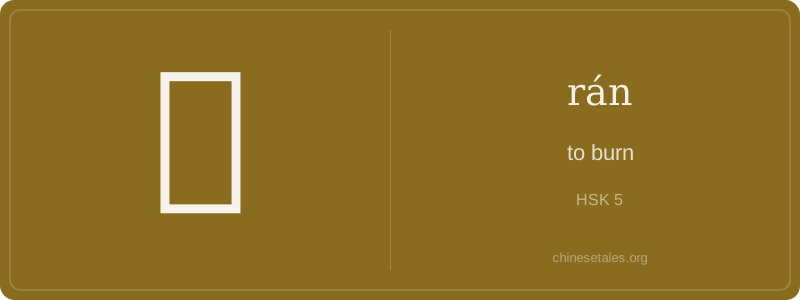
The earliest form of 燃 appears in Warring States bamboo slips—not as a pictograph of fire itself, but as a semantic-phonetic compound: 火 (fire) on the left, and 可 (kě) on the right, originally serving as a phonetic hint. But here’s the twist: 可 itself evolved from a pictograph of a mouth (口) with a ‘stop’ or ‘approval’ mark (丂), later repurposed for sound. Over centuries, 可’s shape simplified and stabilized, while 火 retained its flickering four-dot base—making 燃 a beautifully balanced fusion: visual fire + borrowed sound, not a picture of flame but a carefully engineered sign for ignition.
This character didn’t exist in oracle bone script; it emerged later to fill a lexical gap—distinguishing *intentional, vigorous ignition* from generic heating or cooking. By the Han dynasty, 燃 was already standard in texts describing sacrificial fires and military torches. Its visual rhythm—the rising stroke of 火’s dot and the decisive hook of 可’s final stroke—mirrors the sudden *whoosh* of flame catching. Even today, when writers choose 燃 over 烧, they’re invoking that ancient weight: not just heat, but *awakening*, *sacrifice*, or *irreversible change*.
At its core, 燃 (rán) isn’t just ‘to burn’ like a match—it’s the vivid, active, often dramatic *ignition* of flame: flames leaping, fuel catching, energy releasing. It carries visceral force—think wildfires, fireworks, or passion flaring—not slow smoldering (that’s more 熬 or 烤). Grammatically, it’s a transitive verb that almost always requires an object (e.g., 燃烧天然气, not just *‘it burns’*), and it frequently appears in compound verbs like 燃起 (rǎn qǐ, ‘to ignite [hopes/emotions]’) or passive constructions like 被燃尽 (bèi rán jìn, ‘to be completely consumed by fire’).
Learners often mistakenly use 燃 where they need 烧 (shāo)—the far more general, everyday word for ‘to cook’, ‘to burn’, or ‘to heat’. You’d say 烧水 (shāo shuǐ, ‘boil water’) but never *燃水; you’d say 燃放烟花 (rán fàng yān huā, ‘ignite fireworks’) but not *烧放 fireworks. Also beware: 燃 is rarely used alone—unlike 烧, which can stand solo (e.g., 火在烧), 燃 nearly always appears in compounds or with particles like 起, 尽, or 烧.
Culturally, 燃 evokes intensity and transformation—both physical and metaphorical. In classical texts, it describes ritual pyres (e.g.,《左传》: ‘火烈,民望而畏之,故鲜死焉’—fire’s fierceness inspires awe); today, it fuels idioms like 燃眉之急 (rán méi zhī jí, ‘a pressing crisis’—literally ‘fire burning one’s eyebrows’). Learners who overuse 燃 sound overly literary—or accidentally apocalyptic.