燥
Character Story & Explanation
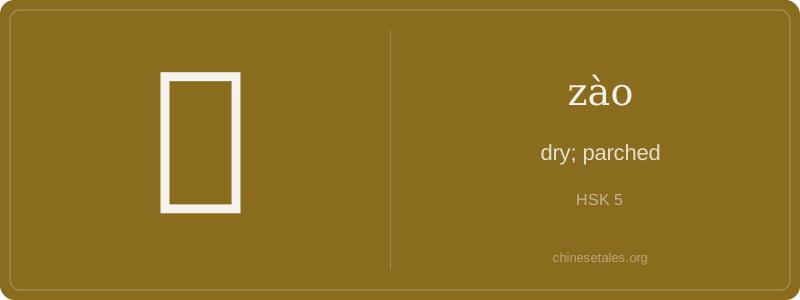
The earliest form of 燥 appears in seal script (c. 3rd century BCE), where it already combined the 火 (huǒ, ‘fire’) radical on the left with 营 (yíng) — a phonetic component later simplified to 單 (dān) and finally to 枣 (zǎo) in modern writing. Visually, it’s fire + ‘date fruit’ (枣), but don’t be fooled: 枣 here serves only as a sound clue (zǎo → zào), while the fire radical anchors the meaning — evoking heat-induced desiccation. Over centuries, strokes streamlined: the top of 枣 lost its decorative dots, the bottom legs shortened, and the fire radical stabilized into its four-dot form.
This visual pairing — fire + phonetic — locked in early on. By the Han dynasty, 燥 was firmly used in medical texts like the *Huangdi Neijing* to describe pathological dryness caused by excessive yang or external heat evils. Unlike generic 干, 燥 always implied *heat-driven* dryness — a nuance preserved for 2,000 years. Its persistence in classical poetry (e.g., Du Fu’s lament about ‘the land burned barren, air thick with 燥 dust’) shows how deeply tied it is to human experience of environmental stress and inner unrest.
At its core, 燥 (zào) isn’t just ‘dry’ like a towel left in the sun — it’s *uncomfortably* dry: parched lips, cracked skin, a throat tight with thirst, or even a mind buzzing with restless impatience. In Chinese, this character carries visceral physicality and emotional heat — think of the traditional medical concept of ‘internal dryness’ (内燥) disrupting yin-yang balance, where dryness isn’t just meteorological but a sign of depleted body fluids or emotional strain.
Grammatically, 燥 is almost always an adjective — never a verb — and rarely stands alone. You’ll see it in compound adjectives like 干燥 (gān zào, ‘arid’) or 燥热 (zào rè, ‘sweltering, humid-heat oppressive’). Crucially, it’s not used for ‘dry’ in neutral contexts: you wouldn’t say *this paper is 燥* — use 干 (gān) instead. Learners often overextend 燥 into everyday ‘dry’ situations, missing its built-in connotation of discomfort, imbalance, or excess heat.
Culturally, 燥 reflects the Chinese holistic view of environment and body as inseparable: a drought-ravaged field and a person with insomnia and red eyes may both be described using 燥 — because both signal an unhealthy surplus of ‘fire’ (the radical!) and deficiency of ‘water’. It’s a linguistic fossil of ancient medical cosmology — still alive in modern weather reports, TCM clinics, and even slang like 心燥 (xīn zào, ‘mentally agitated’).