墙
Character Story & Explanation
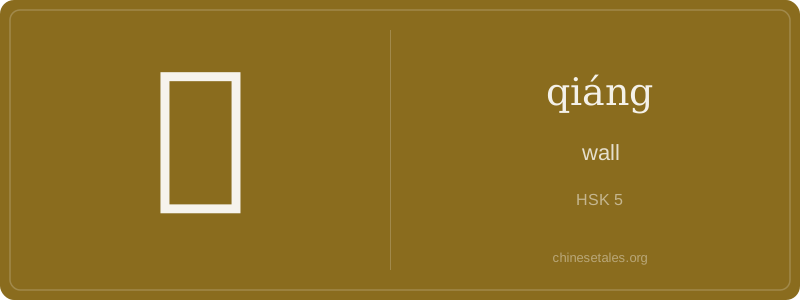
The earliest form of 墙 appears in bronze inscriptions (c. 1000 BCE) as a pictograph showing two parallel vertical lines (representing upright stones or packed earth) sandwiching horizontal strokes (layers of material), all grounded on a base—clearly a wall under construction. Over centuries, the top simplified into 蔷 (originally a separate character meaning ‘rose’ but borrowed here purely for its qiáng sound), while the bottom solidified into 土, anchoring the idea of earthen construction. By the Han dynasty, the structure stabilized: 14 strokes locked in—6 for the top phonetic, 8 for the bottom radical plus connecting strokes.
This evolution mirrors China’s architectural history: early walls *were* rammed earth (hence 土), later reinforced with brick and stone—but the character kept its earthen soul. Classical texts like the *Zuo Zhuan* mention city walls as symbols of sovereignty: ‘有墙者,有国也’ (‘Where there is a wall, there is a state’). Even today, the visual rhythm of 墙—solid base, layered top—echoes the very act of building up, layer by layer, barrier by barrier. It’s a character built to last—and to mean more than mere masonry.
At its core, 墙 (qiáng) isn’t just ‘wall’ as in drywall or brick—it’s a boundary with attitude. In Chinese, it evokes solidity, separation, and sometimes resistance: think Great Wall (万里长城), not hallway partition. The 土 (tǔ, ‘earth/soil’) radical at the bottom screams ‘grounded construction’—walls were literally built from rammed earth in ancient China. That top half, 蔷 (qiáng), is a phonetic component (borrowed for sound, not meaning), but funnily enough, it’s the same character used in 蔷薇 (qiángwēi, ‘rose’)—a delightful sonic coincidence with zero semantic link.
Grammatically, 墙 behaves like a concrete noun but often appears in vivid figurative phrases: 筑墙 (zhù qiáng, ‘build a wall’) means to erect barriers—emotional, political, or bureaucratic; 打破墙 (dǎpò qiáng) isn’t about demolition crews—it’s ‘breaking down barriers’. Learners mistakenly use 墙 for any vertical surface (e.g., ‘whiteboard wall’), but that’s usually 板 (bǎn) or simply 墙面 (qiángmiàn, ‘wall surface’). Also, note: 墙 is almost never used alone in speech—you’ll say 一堵墙 (yī dǔ qiáng, ‘a wall’, with measure word 堵 for solid, upright structures), not just 墙.
Culturally, walls carry layered weight: protection (city walls), division (the Berlin Wall was translated as 柏林墙), and even absurdity—the idiom 隔墙有耳 (gé qiáng yǒu ěr, ‘there are ears beyond the wall’) warns of eavesdropping, revealing how walls imply both privacy *and* permeability. A classic learner trap? Confusing 墙 with other ‘barrier’ words like 屏障 (píngzhàng) — which is abstract and formal — or forgetting that in compounds like 网络防火墙 (wǎngluò fánghuǒ qiáng, ‘firewall’), the metaphor feels completely native to Chinese speakers.