猾
Character Story & Explanation
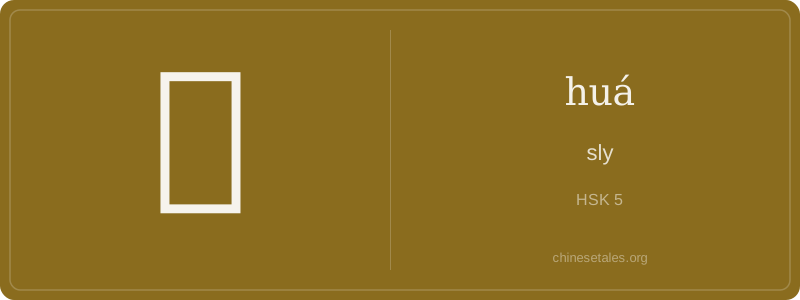
The earliest form of 猾 appears in bronze inscriptions as a combination of 犭 (the 'dog' or 'beast' radical) and 化 (huà, 'to change, transform'). Crucially, 化 itself was originally a pictograph of two people facing each other — one upright, one inverted — symbolizing reversal or disguise. So 猾 began as a vivid image: 'a beast that changes its appearance' — literally, an animal capable of shape-shifting deception. Over time, the right side simplified from full 化 to a streamlined form resembling 华 (huá), though phonetically it retained huá (not huà). The left 犭 remained stable, anchoring the meaning in animal cunning — no human virtue here, just instinctive guile.
This visual logic endured: the beast radical signals instinctual, amoral craftiness — unlike 诈 (deceit), which uses the 'speech' radical (讠) and implies deliberate verbal trickery. Classical usage reinforced this: in the 《战国策》, spies are called '猾士' (huá shì) — not 'wise men', but 'shapeshifting operatives'. By the Tang dynasty, 猾 appears in poetry describing treacherous terrain ('山势狡猾') — extending its meaning to environments that 'deceive the eye'. Its core idea never wavered: unpredictability rooted in disguise, not intellect.
Think of 猾 (huá) as Chinese ‘sly’ — but not the cartoonish, mustache-twirling kind. It’s more like a fox slipping through a fence: clever, quiet, slightly unsettling, and always two steps ahead. In English, 'sly' can be neutral or even charming ('a sly smile'), but in Chinese, 猾 almost always carries moral disapproval — it implies deceit masked by smoothness, like a con artist who never raises his voice. You’ll rarely see it describing a person outright in polite speech; instead, it appears in set phrases like 狡猾 (jiǎo huá) or in written critiques: '他为人狡猾' sounds like a serious character indictment, not light teasing.
Grammatically, 猾 is almost never used alone — it’s a classic 'bound morpheme'. You won’t say *‘这人很猾’ (that person is very sly) — it’s ungrammatical. It only works in compounds (狡猾, 滑猾, 狡猾之徒) or as part of fixed idioms. Even in classical texts, it functions adjectivally only when paired: e.g., 《左传》'其人猾而诈' — note the parallel pairing with 诈 (deceitful). Learners often overuse it solo, mistaking it for a free-standing adjective like 聪明 (smart).
Culturally, 猾 evokes historical suspicion toward excessive cleverness — Confucian values prize sincerity (诚) over sharp wit. A 'sly' person isn’t just tricky; they’re ethically unreliable. That’s why you’ll find 猾 mostly in political analysis, crime reports, or literary villains — never in a job reference! Also, beware tone: huá (second tone) is easily mispronounced as huà (fourth tone, 'to paint') or huá (first tone, 'slippery'), but only huá carries this meaning.