献
Character Story & Explanation
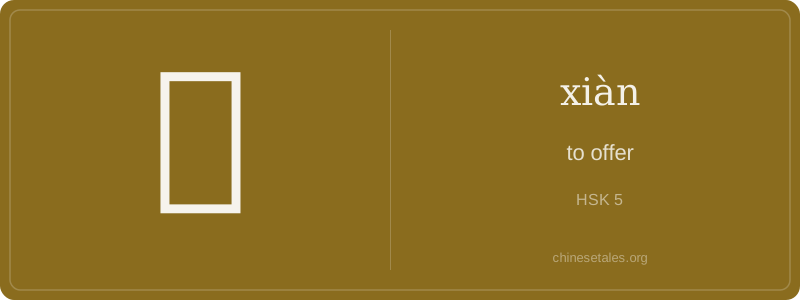
The earliest form of 献 appears on Shang dynasty oracle bones as a vivid pictograph: a dog (犬) standing beneath a hand (手) holding an offering — likely meat or a ritual object. Over centuries, the dog evolved into the radical 犬 (quǎn, ‘dog’), now tucked at the bottom left, while the upper part simplified from a complex hand-and-object glyph into the modern 南 (nán, ‘south’) shape — not because of direction, but due to phonetic borrowing (南 was a close-sounding component in Old Chinese). The 13 strokes crystallized during the Han dynasty: the top 南 (8 strokes) plus the bottom 犬 (4 strokes), with one shared stroke — a visual compromise between sound and meaning.
This character’s journey mirrors China’s evolving rituals: from animal sacrifice to ancestral veneration, then Confucian devotion (e.g., Mencius praising those who ‘献身于义’, ‘devote themselves to righteousness’), and today’s civic idealism — like volunteers 献爱心 across disaster zones. The dog radical isn’t random: dogs were early sacrificial animals and loyal attendants in rites, anchoring the idea of faithful, earnest presentation. So every time you write 献, you’re echoing millennia of hands raised — not in demand, but in humble, purposeful giving.
At its heart, 献 (xiàn) isn’t just ‘to offer’ — it’s to present something precious *with reverence*, often upward: to rulers, ancestors, deities, or ideals. Think less ‘handing over a pen’ and more ‘laying a jade tablet before the emperor’. This vertical hierarchy is baked into the word — you 献 loyalty, 献爱心 (‘offer love’ = volunteer compassion), or 献策 (‘offer a strategy’), always implying humility, sincerity, and social weight. It’s rarely casual; you wouldn’t 献 your lunch to a friend — that’s 给 (gěi) or 送 (sòng).
Grammatically, 献 is transitive and usually followed by 手 (shǒu, ‘hand’) in idioms like 献出 (xiàn chū, ‘to give up/offer up’) or paired with abstract nouns: 献计 (offer advice), 献身 (xiàn shēn, ‘devote oneself’). Note the common pattern: 献 + noun (often abstract) — not 献 + person. You don’t ‘offer him’; you ‘offer *to* him’: 他向祖国献出了生命 (Tā xiàng zǔguó xiàn chūle shēngmìng, ‘He devoted his life to the motherland’).
Learners often misapply it as a neutral synonym for ‘give’, missing its ceremonial gravity — or confuse it with 奉 (fèng), which is even more formal and archaic. Also, be careful: 献 is almost never used in commercial contexts (no ‘献上优惠’!). Its power lies in sincerity, sacrifice, and vertical respect — a linguistic fossil of China’s ritual-centered past still beating in modern civic language.