王
Character Story & Explanation
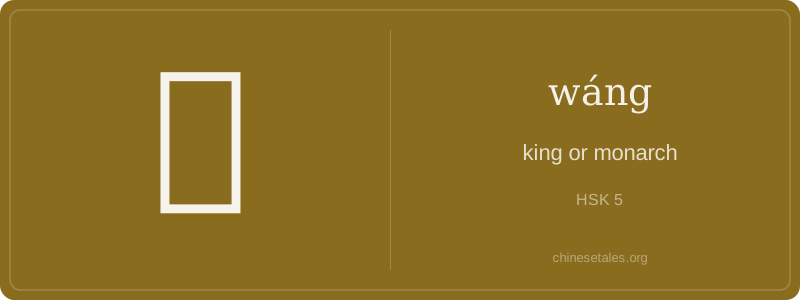
The earliest form of 王 appears on Shang dynasty oracle bones as a bold, axe-like pictograph — three horizontal lines (representing Heaven, Earth, and Humanity) bound by a single vertical stroke, mimicking the ceremonial jade *yuè* axe wielded by rulers to execute justice and command armies. Over centuries, the top and bottom strokes shortened, the middle stroke thickened, and the vertical line straightened, until the Qin small seal script solidified the four-stroke structure we use today: 一 (Heaven), 一 (Earth), 一 (Humanity), and 丨 (the unbroken axis of authority).
This visual logic persisted into philosophy: Confucius called the ideal ruler the ‘Son of Heaven’ who harmonized the Three Realms — a concept literally encoded in 王’s strokes. In the *Analects*, he says, ‘The virtue of the gentleman is like wind; the virtue of the small man is like grass — when the wind blows, the grass must bend’ — subtly echoing 王’s vertical dominance. Even today, calligraphers emphasize the strong, unwavering central stroke: it’s not just writing — it’s embodying sovereignty.
At its heart, 王 (wáng) isn’t just ‘king’ — it’s the distilled essence of sovereign authority in Chinese cosmology: vertical power connecting Heaven (top stroke), Earth (middle stroke), and Humanity (bottom stroke), with the central vertical line binding them all. That’s why it appears not only in words like 国王 (guó wáng, king of a country) but also as a radical in characters related to jade (e.g., 理 lǐ, to reason — originally 'to polish jade'), hinting at ancient associations between royal legitimacy and precious stone.
Grammatically, 王 is mostly a noun or proper noun component, rarely used alone in modern speech — you’ll almost always see it in compounds (e.g., 女王 nǚ wáng, queen; 王子 wáng zǐ, prince). Crucially, it’s *not* used as a verb meaning ‘to rule’ — that’s 主 (zhǔ) or 统治 (tǒng zhì). Learners sometimes mistakenly say *wáng le* for ‘he ruled’, but that’s wrong; 王 is never conjugated. When you hear wàng (third tone), it’s almost always in classical or literary contexts — like 王天下 (wàng tiān xià, ‘to reign over all under Heaven’) — not everyday Mandarin.
Culturally, 王 carries weight far beyond monarchy: in internet slang, 王 can signal elite status (e.g., 游戏王 yóu xì wáng, ‘game king’ = top-tier player), and in compounds like 山大王 (shān dà wáng, ‘mountain bandit chief’), it ironically evokes folk-hero charisma. A common trap? Assuming 王 always means ‘male ruler’ — but 女王 (nǚ wáng) proves gender neutrality in title, unlike English ‘king’. Also, never confuse it with the surname 王 (same character, same pronunciation), which is China’s most common family name — context tells all.