皂
Character Story & Explanation
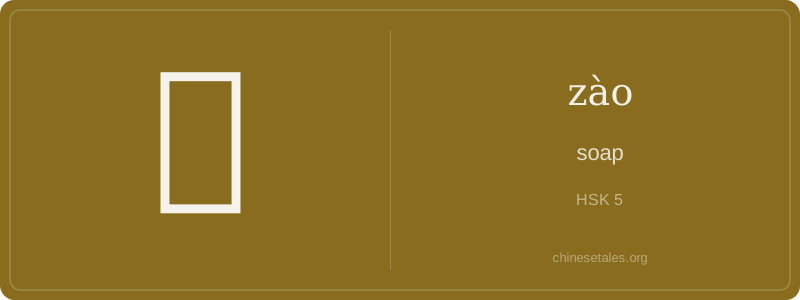
The earliest form of 皂 appears in Han dynasty clerical script (lìshū), not oracle bones — it’s relatively late. Visually, it’s a clever fusion: the top is 白 (bái, ‘white’), written with its characteristic dot-and-horizontal stroke, symbolizing purity and light; below is 七 (qī, ‘seven’), which here isn’t numerical but serves as a phonetic component (ancient pronunciation was closer to *tsʰak*). Over centuries, the 白 became more stylized — the dot sharpened, the horizontal thickened — while 七 simplified from a curved ‘cross’ shape into the clean, angular strokes we see today. Stroke order reflects this logic: first the 白 radical (2 strokes), then the 七 (2 strokes), then the final three strokes completing the lower part — wait, actually, modern standard writing has 7 strokes total: 白 (5 strokes: 丶一丿丨) + 七 (2 strokes: 一) — but note: the bottom ‘seven’ is fused, with the final hook extending to enclose the sense of containment.
Its meaning evolved precisely because of its composition: 白 conveys the *effect* (whitening, purifying), while 七 provided sound and perhaps subtle symbolism — seven being a classical number of completion and ritual (e.g., seven days of mourning, seven stars of the Big Dipper). By the Tang dynasty, 皂 referred specifically to a dark, tar-like soap made from soapberry (zhū yú) fruit ash, used by scholars to clean inkstones — hence its association with scholarly cleanliness. In classical texts like The Book of Rites, 皂 appears in descriptions of palace servants (皂隶, zào lì) — literally ‘black-white attendants’, referencing their dark uniforms and white-cleansed duties — linking the character to service, order, and ritual purity long before detergent existed.
Imagine you’re in a bustling 19th-century Beijing apothecary, where an elderly herbalist grinds dark, fragrant roots into a coarse paste — not for medicine, but for cleaning. He calls it zào, pointing to a small, dense cake wrapped in oiled paper. That’s the soul of 皂: it’s not just ‘soap’ as we know it today (a bubbly, scented bar), but historically, a functional, often rustic cleansing agent made from plant ash and animal fat — earthy, practical, and quietly indispensable. In modern Chinese, 皂 almost never stands alone; it appears only in compounds like 肥皂 (fèi zào, 'soap') or 胰皂 (yí zào, 'glycerin soap'). You’d never say *‘我用皂’* — that sounds archaic or poetic. Instead, it’s firmly embedded in compound nouns.
Grammatically, 皂 is a noun-only character with zero verb or adjective use — no ‘to soap up’, no ‘soapy’. It’s also tone-sensitive: mispronouncing it as zāo (like 糟) or zǎo (like 枣) won’t just sound odd — it’ll conjure spoiled food or dates! Learners often overgeneralize it like English ‘soap’, trying to use it in idioms or verbs (*‘皂化’* exists but means ‘saponification’, a chemistry term — not ‘to soapify’ casually). And yes, it’s HSK 5 — not because it’s hard, but because it’s *rarely used solo*, so learners only meet it in specialized contexts or compound dissection.
Culturally, 皂 carries quiet dignity: it’s the unsung hero of hygiene in pre-modern China, mentioned in Ming dynasty texts like Compendium of Materia Medica (Bencao Gangmu) under ‘cleansing agents’, grouped with charcoal and alum. Its radical 白 (bái, ‘white’) hints at purification — not literal whiteness, but the *result* of cleansing: clarity, purity, readiness. A common mistake? Assuming it’s interchangeable with 洗发水 (xǐ fà shuǐ, shampoo) or 沐浴露 (mù yù lù, body wash) — nope. 皂 is strictly solid, traditional, and compound-bound.