糙
Character Story & Explanation
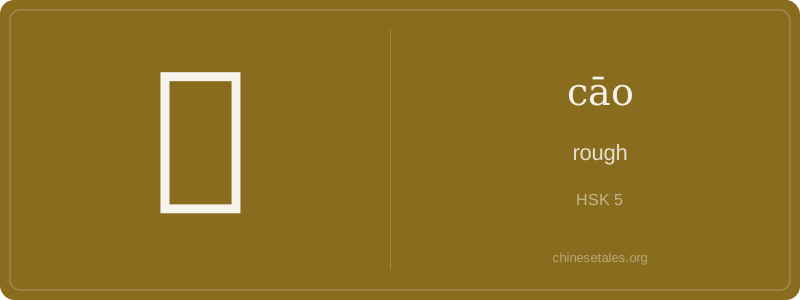
The earliest form of 糙 appears in seal script (c. 3rd century BCE), built around 米 (mǐ, ‘rice’) on the left — unmistakably depicting six rice grains in a stylized cluster — and 召 (zhào) on the right, originally a hand reaching toward a mouth (later simplified to its modern shape). The 米 radical wasn’t decorative: ancient Chinese milled rice by pounding unhulled grains in mortars, and the resulting product was literally ‘rough rice’ — full of bran and husk fragments. Every stroke in the modern 16-stroke form echoes this: the top dots of 米 suggest scattered grain particles; the jagged right side (召) evokes the forceful, irregular motion of pounding.
By the Han dynasty, 糙 appeared in texts like the Shuōwén Jiězì (c. 100 CE) defined as ‘unpolished rice’ — a concrete, agricultural term. Over centuries, its meaning broadened metaphorically: just as unpolished rice lacks smoothness, so too could speech (糙话, cāo huà, ‘vulgar talk’), craftsmanship (糙活儿, cāo huór, ‘shoddy work’), or even moral character (糙脾气, cāo píqì, ‘gruff temper’). Its visual duality — grain + force — cemented its core idea: *resistance to refinement*, whether physical or cultural.
Imagine running your fingers over unpolished rice grains fresh from the husk — gritty, uneven, stubbornly resistant to smoothness. That’s 糙 (cāo): not just ‘rough’ as in sandpaper, but *texturally unrefined*, *unprocessed*, *lacking polish* — whether describing coarse fabric, a grating voice, or even a hastily written draft. It carries a slight negative weight: you wouldn’t call fine art 糙, but you might call last night’s rushed email draft 糙得不行.
Grammatically, 糙 is almost always an adjective and rarely stands alone — it’s nearly always paired: 糙糙的 (cāo cāo de, ‘roughish’), 糙得很 (cāo de hěn, ‘extremely rough’), or in compounds like 粗糙 (cū cāo, ‘coarse/rough’ — note the near-synonym pairing with 粗). Learners often mistakenly use it like English ‘rough’ for surfaces only; but in Chinese, it extends to abstract qualities — a 糙的计划 (cāo de jìhuà) means a ‘half-baked, underdeveloped plan’, not just a bumpy one.
Culturally, 糙 reflects China’s agrarian roots: its radical 米 (rice) anchors it in the physical reality of unmilled grain — the literal opposite of refinement. Modern slang has reclaimed it playfully: 糙汉 (cāo hàn, ‘rough man’) affectionately describes a rugged, unpretentious guy, while 糙生活 (cāo shēnghuó, ‘rough life’) humorously embraces imperfect, low-effort living — think mismatched socks and instant noodles. The trap? Confusing it with 粗 (cū), which is broader (‘thick’, ‘crude’) and far more common.