纷
Character Story & Explanation
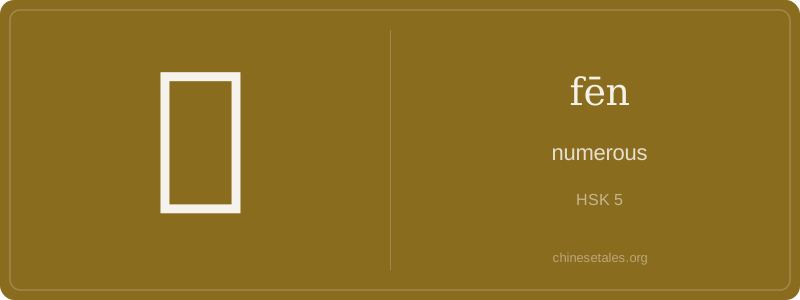
The earliest form of 纷 appears in bronze inscriptions as a combination of 糸 (a simplified pictograph of twisted silk threads) and 分 (a hand dividing something). Imagine ancient scribes carving two parallel strands of silk — then a hand slicing *between* them, causing the filaments to separate, flutter, and multiply outward. Over centuries, 糸 shrank into the modern left-side radical 纟 (sī, ‘silk’), while 分 remained on the right, now stylized but retaining its ‘division’ essence — not as separation, but as the *act of proliferation* that follows rupture.
This visual logic shaped its meaning: when silk unravels, threads don’t vanish — they multiply, tangle, and scatter in abundance. By the Han dynasty, 纷 was already used in poetry like the Chu Ci to describe ‘fluttering banners’ and ‘swirling clouds’. Its semantic journey reflects a profound Chinese insight: abundance isn’t passive — it’s dynamic, interconnected, and born from gentle disruption. Even today, 纷 never implies randomness; it suggests patterned multiplicity — like cherry blossoms falling *in sequence*, not chaos.
At its heart, 纷 (fēn) isn’t just ‘numerous’ — it’s *chaotically numerous*, like petals swirling in a gust or gossip spreading through a crowded teahouse. The character evokes movement, multiplicity, and often a touch of beautiful disorder. Its core feeling is visual and kinetic: things multiplying, scattering, interweaving — never static, never singular.
Grammatically, 纷 almost never stands alone. It’s a classic adverbial modifier, nearly always paired with verbs like 落 (luò, to fall), 扬 (yáng, to lift/scatter), or 呈现 (chéngxiàn, to present). You’ll see it as 纷纷 (fēnfēn) — the reduplicated form that’s indispensable at HSK 5. Note: it doesn’t mean ‘many’ like 多 (duō); it means ‘in rapid, overlapping succession’ — think ‘one after another’, ‘in droves’, ‘en masse’. Learners often mistakenly use it as an adjective before nouns (e.g., ×纷人群); correct usage is adverbial: 纷纷离开 (fēnfēn líkāi, ‘leave one after another’).
Culturally, 纷 carries poetic weight — it appears in classical lines describing falling snow, migrating geese, or surging emotions. A common pitfall? Confusing it with 分 (fēn, ‘to divide’) due to identical pronunciation. But while 分 splits things apart, 纷 multiplies and scatters them *together* — like threads from a fraying rope, all still connected by the silk radical 纟. That subtle distinction — connection amid chaos — is the soul of this character.